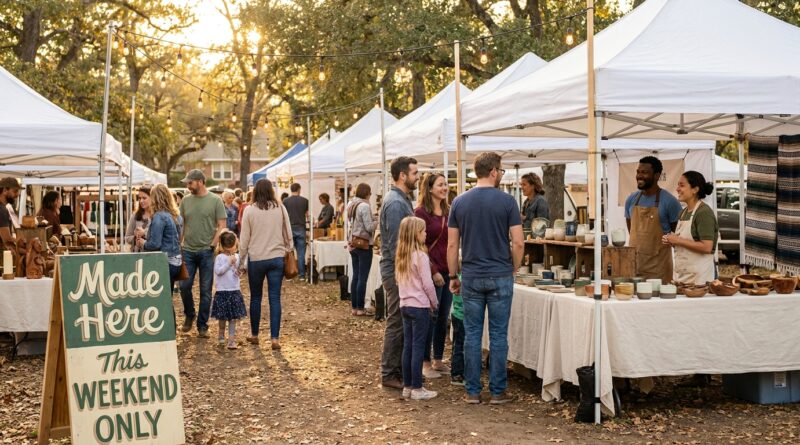
The Hyper-Local Long Weekend Pop-Up: How Holiday Markets Are Quietly Becoming Neighborhood Micro-Malls
You want to support local. Then the long weekend shows up, you need a gift, a snack, a candle, maybe a last-minute house item, and somehow you end up under fluorescent lights at a chain store or half-asleep on a giant shopping app. It is frustrating because the people making great things in your own city are often right there, just not easy to find. The good news is that parks, plazas, brewery patios, schoolyards, and closed-off side streets are quietly turning into neighborhood micro-malls during Labor Day weekends, First Friday nights, and seasonal street fairs. These pop-up markets are where nearby makers sell small-batch food, textiles, art, skincare, ceramics, and home goods face to face. If you know how to spot the pattern, finding a local makers market near me stops feeling random and starts becoming part of your weekend routine.
⚡ In a Hurry? Key Takeaways
- Holiday weekends and monthly art nights now act like temporary neighborhood shopping districts for local makers.
- Search event calendars, Instagram, library boards, and terms like “local makers market near me” plus your neighborhood name to build a reliable list.
- Buying in person gives you better quality checks, direct access to the maker, and puts more of your money into your local economy.
Why these pop-ups matter more than they look
From a distance, a holiday market can seem small. A few tents. Some music. A coffee truck. But walk through one and you realize what is happening. It is not just shopping. It is a temporary retail district made up of people who live and work nearby.
Instead of one giant store buying from far away, you get dozens of independent sellers in one place. A soap maker. A print artist. A baker. A leather worker. A candle brand that is still run out of a local studio. That is why these events feel a lot like micro-malls. They gather many categories of goods into one easy stop, but without the sameness.
That shift matters for both sides. Shoppers get better stories, better variety, and often better quality. Makers get direct sales, instant feedback, and repeat customers who can come back next month.
Why they are still so easy to miss
This is the annoying part. Many of the best local markets are not marketed like major retail events. They may live on an Instagram post, a city calendar page, a flyer in a coffee shop, or a brewery’s event tab that gets updated three days before the event.
Some only happen on First Fridays. Others appear on long weekends, during harvest season, or around neighborhood festivals. A few rotate locations. So if you are waiting for one big central directory to tell you everything, you may be waiting a while.
That is why a simple search like local makers market near me works best when you treat it as a starting point, not the final answer.
How to actually find a local makers market near me
Start with the obvious, then get more specific
Search broad first, then narrow fast. Try combinations like these:
- local makers market near me
- makers market [your city]
- First Friday market [your neighborhood]
- holiday market [your city]
- artisan market [your zip code]
- handmade market near [local park or downtown district]
If search results are thin, switch to Maps, Events, and Instagram. Many organizers post there first.
Check the places that already gather people
The best markets often happen where foot traffic already exists. Look at:
- Downtown business improvement district pages
- Parks and recreation calendars
- Public library event boards
- Breweries, food halls, and coffee roasters
- Art walks and First Friday pages
- Farmers market websites that host maker add-ons
- Neighborhood Facebook groups
These places already have the audience, so they make natural homes for pop-up retail.
Follow organizers, not just individual vendors
This is the trick most people miss. One maker may post one booth date. An organizer posts the whole season. Once you find one market you like, follow the host account, venue, and event producer. That one move can turn a random find into a steady calendar of local shopping options.
What to expect when you go
Think of these markets as a smarter version of impulse shopping. You still get the fun of browsing, but there is more intention behind what you buy.
You can ask who made the item. You can feel the fabric. You can smell the soap before buying it. You can ask whether the hot sauce is mild or dangerous. You can learn if the ceramic mug is dishwasher safe. That sounds simple, but it is a huge advantage over buying from a generic listing online.
You also see patterns in your city. Maybe your neighborhood has more textile artists than you realized. Maybe there is a cluster of local skincare brands using regional ingredients. Maybe the baker you like also stocks a nearby cafe during the week. Those little discoveries help a local economy connect.
How to shop these markets without getting overwhelmed
Go in with three categories
If you try to browse everything with no plan, you may either overspend or walk out with nothing. Pick three categories before you arrive. For example:
- One food item for now
- One gift item for later
- One home item only if you love it
That keeps your spending focused while leaving room for a great surprise.
Do one full lap first
Markets are not warehouses. A lot of items are one-offs or small runs. Still, it helps to walk through once before buying the first candle or tote bag you see. You may find a version you like more two rows later.
Bring a backup payment method
Most vendors take cards, tap-to-pay, or payment apps. Some do not. A little cash helps, especially for food, lower-cost goods, or places with weak cell service.
Ask one practical question before buying
Try something useful, not awkward. Ask how to wash it, store it, use it, or gift it. Good makers usually love talking about the thing they made, and you get a better sense of quality right away.
Why this is good for makers, not just shoppers
Direct sales are only part of the story. Makers also learn what people pick up, what they ask about, what price points work, and which products get repeat attention. That feedback is gold for a small business.
If five shoppers ask whether a balm comes unscented, that maker has a clear next step. If one print style sells out while another sits, the artist learns fast. Pop-up markets are not just sales tables. They are real-world research labs.
There is a nice overlap here with the rise of hands-on neighborhood making. If you have noticed more local workshops, sewing circles, and craft meetups lately, that is part of the same pattern. The Hyper-Local Analog Comeback: How Neighborhood Craft Circles Are Quietly Becoming Micro-Studios shows how these small creative communities are turning into real production networks. Markets give those makers a place to test and sell what they create.
Build your own simple market map
You do not need a complicated system. A notes app and a calendar are enough.
Make a short list with five columns
- Market name
- Location
- How often it happens
- Best source for updates
- What it tends to sell
After two or three weeks, you will start seeing a rhythm. Maybe the arts district hosts First Fridays. Maybe the park does a makers market every holiday weekend. Maybe the church lot becomes a craft fair every third Saturday in fall. Once the pattern clicks, it gets much easier to plan around it.
Set one recurring reminder
Pick one day a month to check your list. Ten minutes is enough. This is the difference between vaguely wanting to support local and actually showing up with a tote bag and a budget.
At a Glance: Comparison
| Feature/Aspect | Details | Verdict |
|---|---|---|
| Convenience | Big-box stores are predictable, but local pop-up markets can bundle many nearby brands into one walkable stop during weekends and evening events. | Micro-markets take a little planning, but they are worth it. |
| Product Experience | At maker markets, you can touch, smell, taste, try, and ask questions directly to the person who made the item. | Better for gifts, home goods, and anything where quality matters. |
| Local Impact | More of your spending stays with independent neighbors, and makers get direct feedback they can use to improve and grow. | Best choice if you want your weekend spending to mean something close to home. |
Conclusion
The next time a long weekend creeps up and you feel yourself defaulting to the usual big-box run or endless marketplace scroll, pause and check what is happening in your own zip code first. Right now, across the country, Labor Day style weekends and First Friday nights are quietly turning parks, plazas, and side streets into temporary hyper-local malls packed with small-batch food, textiles, art, skincare, and home goods from nearby makers. Plugging into these recurring but easy-to-miss markets does two useful things at once. It shifts impulse spending away from distant supply chains and into the pockets of independent neighbors, and it gives local manufacturers a predictable boost in sales and real customer feedback they can use to grow. A simple habit, search for a local makers market near me, save the dates, and show up, can turn one household’s weekend plans into real support for the people making things in your own backyard.