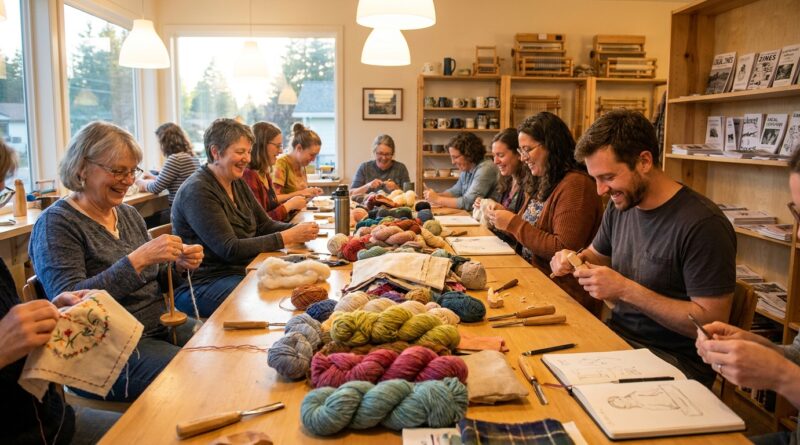
The Hyper-Local Analog Comeback: How Neighborhood Craft Circles Are Quietly Becoming Micro-Studios
You can feel the burnout. Too much scrolling, too much same-looking stuff, too little that feels made by an actual person a few blocks away. A lot of people want to use their hands again, but walking into a serious ceramics studio or woodworking shop can feel like showing up to a pickup basketball game where everyone else played in college. That is where hyper local craft circles are quietly changing things. In neighborhoods across places like Detroit and Chicago, people are gathering around folding tables, library rooms, church basements, maker spaces, and back patios to knit, carve, print, stitch, bind, repair, and test ideas together. Not as polished brands first, but as neighbors. These groups are part hobby night, part skill swap, part tiny business lab. Best of all, they are low-pressure. You do not need a logo, a website, or pro gear to join. You just need to show up, make something, and keep going.
⚡ In a Hurry? Key Takeaways
- Hyper local craft circles are becoming easy entry points for people who want offline community and hands-on making without the pressure of a pro studio.
- If you want to start, begin with a weekly open table, a simple shared tool list, and one craft focus like knitting, zines, mending, or woodcarving.
- These circles work best when they stay low-cost, beginner-friendly, and clear about safety, especially when tools, blades, heat, or chemicals are involved.
Why these neighborhood craft groups are taking off
People are tired of being consumers all the time. Buying another thing online is easy. It is also weirdly empty after a while.
Making something with your own hands scratches a different itch. It slows your brain down. It gives you proof that your time turned into something real. A scarf. A spoon. A risograph poster. A stack of hand-bound zines. Even a repaired jacket can feel more satisfying than a brand-new purchase.
That is a big reason hyper local craft circles are growing. They offer something the internet cannot. Real faces. Shared tools. Small mistakes. Tips passed across the table. A sense that you belong somewhere without needing to perform.
What makes a craft circle different from a class or studio
A class usually has a teacher, a set project, and a clock ticking. A pro studio often has higher fees, stronger expectations, and a learning curve that can scare people off.
A craft circle is looser. You bring what you are working on, or borrow something simple to start. Some people are experienced. Some are absolute beginners. The point is not perfection. The point is practice, company, and momentum.
Think of it as a micro-studio
This is the interesting shift. These groups are not just social clubs anymore. Many are turning into informal micro-studios. That means people are not only making for fun. They are also trying tiny product ideas in a low-risk way.
A fiber artist may test a new dyed yarn colorway with ten neighbors before putting it online. A zine-maker may swap prints and see what people actually pick up. A woodcarver may learn that bottle openers sell faster than wall art. That feedback is gold, and it comes before rent, wholesale orders, or marketplace fees enter the picture.
Why hyper local matters so much
Local is often used as a fuzzy marketing word. Hyper local is more specific. It means the people making, buying, swapping, and learning are actually near each other. Same neighborhood. Same bus route. Same weekend market.
That closeness changes everything. Trust builds faster. Tools get shared more easily. People return because the meetup fits into normal life.
You can see a similar neighborhood-first pattern in food and drink too. The piece The Hyper-Local Grain Loop: How Neighborhood Distillers Are Quietly Turning Nearby Farms Into Flavor Powerhouses shows how local systems get stronger when makers work with nearby sources instead of chasing scale first. Craft circles follow that same logic, just with yarn, paper, thread, wood, ink, fabric, and know-how.
Who these circles are for
Not just artists. Not just side hustlers. Not just retirees with lots of free time.
They work for parents who need one night a week away from screens. For office workers who want their hands back. For people new to a city. For folks who miss making things but do not want to spend hundreds on equipment before they know if they will stick with it.
They are also a great fit for people who do not yet see themselves as “makers.” That label can feel too big. A circle makes it smaller and friendlier. You are not becoming a brand. You are just showing up with a project.
How a simple meetup turns into a micro-studio
Step 1: People gather around one repeated time and place
Consistency matters more than polish. Every Thursday at 7 p.m. in the library annex. Every Sunday afternoon at the community center. That rhythm is what turns a one-off event into part of neighborhood life.
Step 2: Skills start moving sideways
One person knows bookbinding. Another knows mending. Another has a button maker. Nobody has to be the expert in everything. The group gets stronger as knowledge moves across the room.
Step 3: Shared tools lower the cost of entry
This is huge. When a circle shares cutting mats, carving knives, looms, sewing machines, screen printing frames, or even just decent scissors, beginners do not have to buy a full setup on day one.
Step 4: Tiny products get tested in public
A maker brings five handmade notebooks. Another brings two carved kitchen tools. Another brings sticker sheets or hand-dyed bandanas. People react in real time. What gets picked up? What gets ignored? What price feels fair? That is better feedback than guessing alone.
How to find hyper local craft circles near you
Start smaller than you think. Skip the big search for “best studio in my city” and look for neighborhood signals.
Places to check
Libraries are often the easiest place to start. Many now host knitting circles, repair cafes, zine nights, and open craft tables.
Community centers, church halls, park district buildings, and independent coffee shops are also common hosts. So are art co-ops and maker spaces with beginner nights.
Look at bulletin boards. Yes, real ones. Also neighborhood Facebook groups, local subreddit threads, community newsletters, and Instagram accounts for small art spaces.
What to search for
Try terms like “mending club,” “stitch and bitch,” “open craft night,” “zine meetup,” “maker circle,” “fiber meetup,” “print club,” “community woodshop beginner night,” or “repair cafe” plus your neighborhood name.
If nothing appears, that does not mean it does not exist. It may just be badly advertised. Ask librarians, café owners, art teachers, and market vendors. They usually know who gathers where.
How to walk in without feeling out of place
This is the part that stops a lot of people. You worry everyone will be more advanced. You worry you will need the right supplies. You worry it will be cliquey.
That does happen sometimes. But good circles make room for beginners on purpose.
Use this low-stress approach
Message ahead and ask three things. Is it beginner friendly? Do I need to bring anything? Is there a simple first project people recommend?
Then bring one small project, not your grand creative dream. A scarf square. A zine draft. A simple spoon blank. A visible mending patch. Small wins make it easier to come back.
If you want to start one, keep it boring at first
Boring is good. Boring means dependable.
What you actually need
You need a place with tables, chairs, decent light, and a restroom. You need a repeating schedule. You need a simple description. That is enough to begin.
Try something like: “Neighborhood Craft Table. Wednesdays, 6 to 8 p.m. Bring any portable project. Beginners welcome. Some shared tools available.”
Set a few ground rules
Make the space welcoming. Be clear that people should ask before giving advice. Label tools. Clean up after use. Keep fragrance low if possible. If sharp tools or heat tools are allowed, say so clearly.
Start with one lane, then widen
A focused group is easier to launch than an everything club. Start with fiber arts, zines, mending, or whittling. Once a core group forms, let adjacent crafts join.
How these circles help people test small business ideas without big risk
This is where the “micro-studio” idea gets practical. A lot of people have a half-formed thought in the back of their head. Maybe I could sell these. Maybe people would buy my prints. Maybe my hand-stitched pouches are good enough.
A craft circle gives you a softer runway. You can show neighbors what you are making before spending money on branding, packaging, or an online shop. You get honest reactions from people who are not abstract followers or random clicks.
Useful questions neighbors can answer
Would you actually use this? Which color would you pick? Is this a gift item or an everyday item? Does this price feel fair? What size works best?
That kind of feedback can stop you from sinking time into products nobody wants, or help you see value in the ones people keep reaching for.
Why this matters beyond hobbies
It is tempting to treat craft circles as a cute trend. They are more than that.
They fight isolation. They pass along practical skills. They give younger and older neighbors a reason to sit together. They help people repair and reuse instead of toss and replace. They create a very small, very real pipeline from hobby to income.
And maybe most important, they widen the idea of who gets to make things for a community. Not just big brands. Not just formal manufacturers. Ordinary people too.
Watch-outs before a group grows too fast
Do not let it become too gear-heavy
If newcomers feel they need $500 in supplies to join, the group will shrink into a tiny club. Keep shared basics available when possible.
Do not let experts dominate the room
Strong personalities can accidentally turn a circle into a critique session. That scares beginners off fast. Keep the mood helpful, not performative.
Take safety seriously
Needles and thread are one thing. Saws, blades, torches, inks, solvents, and kilns are another. If the group uses anything risky, have clear rules, protective gear, and limits on what can happen in a casual meetup.
At a Glance: Comparison
| Feature/Aspect | Details | Verdict |
|---|---|---|
| Ease of entry | Craft circles usually need fewer supplies, lower fees, and less confidence than formal studios or classes. | Best option for beginners. |
| Community value | Neighbors share skills, tools, encouragement, and local feedback in person. | High value, especially for fighting isolation. |
| Path to small sales | Makers can test tiny product ideas with real people before opening a shop or investing heavily. | Smart, low-risk ramp for new makers. |
Conclusion
Hyper local craft circles are not trying to replace the internet or turn every hobby into a brand. That is part of their appeal. They give people a weekly table, a real place to be, and a low-pressure way to make something with others instead of alone. Right now, social crafting meetups are growing fast in cities like Detroit and Chicago because they offer something a lot of people miss. Offline connection that feels useful, human, and calming. If you have been craving that, this is a very workable model. Knitters, woodcarvers, zine-makers, menders, printers, and fiber artists can sit side by side, share tools and tips, and even test small product ideas with neighbors before opening a shop. That helps communities now. It builds skills, cuts isolation, and gives the next wave of backyard makers a simple way in. You do not need to call yourself a manufacturer. You just need a chair, a table, and a reason to come back next week.