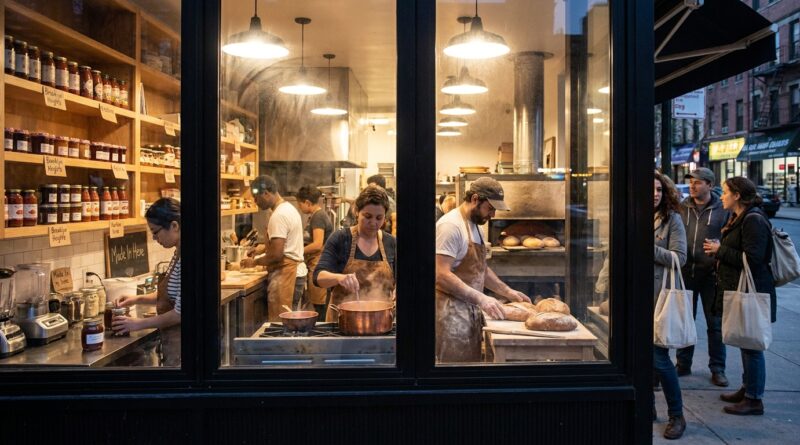
The Hyper‑Local Food Workshop: How Neighborhood Kitchens Are Quietly Becoming Your Town’s Most Important Factories
You feel it every time the store shelves look picked over, or when the “local” jam on the label actually came from three states away. People want food that is fresher, closer, and less tied to shaky global shipping. Small makers want that too. But the baker down the street, the family that makes chili oil, or the neighbor brewing kombucha often gets stuck in a weird middle zone. They are too big for hobby status, too small for full factory life, and buried under rules, rent, and equipment costs. That is where a hyper local food manufacturing community kitchen starts to matter. Think of it as a shared workshop for food. It gives local makers licensed space, shared tools, and a path to steady production. For residents, it turns “support local” from a slogan into something useful. Bread, sauces, soups, dumplings, pickles, and ready-to-heat meals can come from a place you can actually walk to.
⚡ In a Hurry? Key Takeaways
- A hyper local food manufacturing community kitchen helps towns turn small food makers into dependable neighborhood suppliers.
- Start with shared licensed space, simple scheduling, and a few staple products people buy every week, not just festival treats.
- Done right, this model lowers risk for makers, keeps food safety standards in place, and keeps more money circulating close to home.
Why neighborhood kitchens matter more than they look
Most people do not think of a community kitchen as a factory. That is the mental shift. It is not a giant warehouse with forklifts and loading docks. It is a small production hub. It takes skills that already exist in a town and gives them room to grow.
Maybe your area already has a church kitchen that sits empty most weekdays. Maybe a former cafe has a good prep space but no tenant. Maybe a school, grange hall, or nonprofit has equipment that gets used only a few hours a week. A shared kitchen can turn those underused spaces into real production capacity.
That matters because food resilience is not just about having farms nearby. It is also about processing, packaging, storing, and distributing what people actually eat during the week. Flour is nice. A loaf of bread on Tuesday morning is better.
What a hyper local food manufacturing community kitchen actually does
At its best, this kind of kitchen sits between cottage food laws and full industrial scale. It gives makers access to things that are hard to afford alone.
Shared equipment
Mixers, ovens, blast chillers, prep tables, sinks, refrigeration, labeling stations, and dry storage cost real money. Shared access changes the math. A salsa maker does not need to buy every piece of equipment on day one. A soup business can test demand before signing a lease.
Licensed production space
This is a big one. Many home-based businesses hit a ceiling because they cannot legally make certain products at home, or cannot expand into wholesale. A properly permitted kitchen gives them a path forward.
Batch production instead of one-off selling
Farmers markets are great for testing. They are not always great for building a routine local supply. A shared kitchen lets makers move from “I sold out on Saturday” to “I deliver 80 jars every Tuesday and restock three neighborhood shops on Friday.”
Simple logistics close to home
If products travel two miles instead of 2,000, freshness goes up and complexity goes down. Fewer middlemen. Less packaging. Faster feedback from customers.
Why this works better than people expect
Small food businesses often fail for boring reasons, not because the food is bad. Rent is too high. Rules are confusing. They cannot get enough fridge space. They lose hours driving to faraway commissary kitchens. They make great products, but the system around them is clumsy.
A shared neighborhood workshop fixes many of those boring problems at once. It lowers startup risk. It also helps makers stay independent longer. They do not have to jump straight from home stove to massive outside investor. They can grow in steps.
That is one reason this model is getting more attention. If you want a wider view of how tiny producers are turning into real local manufacturing engines, this piece on From Backyard Bees To Blockwide Brands: How Hyper‑Local Food Producers Are Quietly Building New Micro‑Manufacturing Models lays out the bigger pattern well.
What towns should make in these spaces first
Not every kitchen should try to make everything. The smart move is to start with food that people buy often and that fits local demand.
Good starter categories
Bread and baked goods. Sauces and condiments. Fermented foods. Ready-to-heat meals. Soups. Dumplings. Tortillas. Preserves. Salad dressings. Spice blends.
These are useful because they fit daily life. They are not novelty items. They can become part of a family’s normal routine.
Think weekly essentials, not just giftable treats
This is where many small makers get stuck. It is easier to sell a fancy jar of something once than to become part of someone’s Tuesday dinner plan. A community kitchen should focus on staples people reorder.
Ask simple questions. What do local parents need at 6 p.m.? What can older residents reheat easily? What products reflect the food traditions already living in the neighborhood?
For residents, this is how “buy local” gets practical
People often want to support local food, but they do not want support to feel like homework. They need food that is affordable, nearby, and easy to pick up.
A neighborhood kitchen can make that happen through pickup lockers, corner store partnerships, weekly subscriptions, and rotating menus. Instead of waiting for the Saturday market, residents can grab local noodles, soup, flatbread, or kimchi during a normal errand run.
That changes local food from occasional to dependable. Once that happens, habits shift. So does money flow.
For small makers, this is the bridge out of “side hustle forever”
Many talented cooks and bakers do not need motivational speeches. They need a legal sink, a mixer they do not have to finance alone, and help with labels and permits.
A hyper local food manufacturing community kitchen can offer:
- Hourly kitchen rentals
- Cold and dry storage
- Shared purchasing for containers and ingredients
- Food safety training
- Help with licensing and inspections
- Basic bookkeeping or order management support
- Group delivery routes to nearby shops and pickup points
That support matters because paperwork is often the silent killer. A lot of great products never grow because the founder is spending late nights guessing at rules.
The boring part that makes or breaks it
Now for the less glamorous truth. Shared kitchens fail when they are run like a nice idea instead of a real operation.
Clear rules
Who can use the kitchen. For what products. During what hours. With what cleaning steps. None of this can be fuzzy.
Scheduling that people trust
If two bakers need the ovens at 5 a.m. every Thursday, somebody is going to be upset unless the system is clear. Good software helps, but even a simple and fair schedule beats chaos.
Storage discipline
Shared dry goods, private ingredients, allergen control, expiration dates, and cold storage all need labels and routines. This is not optional.
A path to sales
A kitchen alone is not enough. Makers need routes to customers. Local grocers, schools, cafes, office lunch programs, apartment pickup spots, and CSA add-ons can all help.
How a town can start small without making a mess
You do not need to build a shiny food hub from scratch. In fact, that is usually the wrong first step.
Step 1: Map what already exists
Look for underused licensed kitchens, local cooks with demand, and buyers who want local supply. Churches, VFW halls, schools, nonprofits, and closed restaurants are worth checking.
Step 2: Pick three to five products people already want
Do not launch with 40 ideas. Start with proven demand. Bread. Prepared meals. Sauces. Pickles. Snacks. Make the first wins boring and steady.
Step 3: Solve compliance together
Bring in the health department early. This is not the enemy. Early conversations can prevent expensive mistakes later.
Step 4: Build repeat buying, not just launch excitement
Weekly subscriptions, school pickup, local store shelves, and office orders are stronger than one big opening weekend.
Step 5: Track what works
Which products reorder. Which hours are overbooked. Which makers need cold storage. Which neighborhoods buy most often. Small data beats big guessing.
What success looks like after a year
Success is not just social media buzz. It looks more ordinary than that. A local freezer stocked with soups made three blocks away. A baker who moved from weekend pop-ups to daily wholesale. A refugee family selling a traditional sauce legally and profitably. A retired cafeteria kitchen back in use. A small grocer getting reliable nearby supply when a big distributor is late.
It also looks like trust. Residents know who made the food. Makers know who bought it. That face-to-face loop is a real economic advantage, not just a feel-good story.
Common worries, answered plainly
“Is this only for trendy, expensive food?”
It should not be. If the model only produces luxury jam for tourists, it is missing the point. The strongest version makes useful everyday food.
“Can small kitchens really matter at scale?”
Yes, because resilience often comes from many small nodes, not one giant center. Ten neighborhood producers can be less fragile than one distant supplier.
“Won’t food safety be a problem?”
It can be, if the kitchen is sloppy. But licensed shared kitchens with proper cleaning, training, storage rules, and inspections can be far safer than informal side production.
“Do makers lose their identity in a shared space?”
No. If anything, they keep more of it. Shared infrastructure lets them grow without handing everything over to a large outside manufacturer.
At a Glance: Comparison
| Feature/Aspect | Details | Verdict |
|---|---|---|
| Home kitchen side hustle | Low overhead, but limited by space, equipment, and local rules. Hard to scale into steady weekly supply. | Good for testing. Weak for dependable local production. |
| Shared community kitchen | Licensed space, shared tools, lower startup risk, room for multiple makers, easier path to wholesale and repeat orders. | Best balance for towns that want practical, resilient local food manufacturing. |
| Large outside co-packer or factory | Can handle volume, but often costs more upfront, adds distance, and can weaken local identity and flexibility. | Useful later for some brands, but not the best first step for community resilience. |
Conclusion
Communities do not need to wait for some giant rescue plan to make food systems less fragile. A shared neighborhood food workshop is one of the quickest, most concrete moves a town can make. It turns existing skills and underused kitchen space into steady, hyper-local production of bread, sauces, prepared meals, preserves, and other basics people actually need. It lowers risk for new makers, helps cultural food traditions stay alive, and keeps more spending close to home. Best of all, it replaces vague “support local” talk with something you can see, taste, and walk to. If your town wants stronger supply chains and more real-world connection, a hyper local food manufacturing community kitchen is not a side project. It is infrastructure.