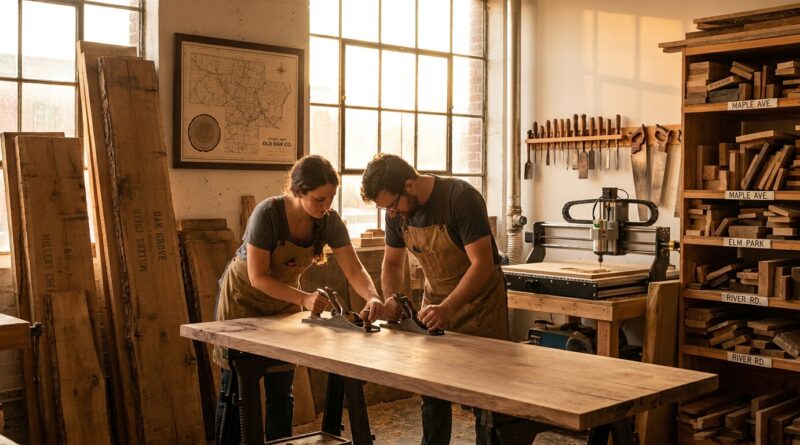
The Hyper-Local Lumber Comeback: How Neighborhood Woodshops Are Turning Supply Shocks Into ‘Grown-Here’ Products
You order a simple shelf, a bathroom vanity, or a dining table, and suddenly it is six weeks out, twelve weeks out, or “temporarily unavailable.” When it does arrive, it may look fine at first, then wobble, chip, or peel like it was built to survive one move and not much else. That frustration is real. What is easy to miss is that while big-box furniture and national lumber chains get shakier, many local woodworkers are sitting just a few miles away, ready to build better pieces but struggling to get steady orders. That gap is creating a quiet comeback for hyper local lumber local woodshop furniture. The idea is simple. Use nearby trees, local micro-mills, and neighborhood shops to make shelves, tables, cabinets, and fixtures closer to home. With national sawmill capacity tightening and prices staying jumpy, “grown-here” wood products are starting to look less like a niche and more like a smart backup plan.
⚡ In a Hurry? Key Takeaways
- Local woodshops can often replace backordered mass-market furniture with custom pieces made from nearby timber.
- Start by asking local arborists, cabinet shops, and small sawyers if they source wood within your county or region.
- Traceable local wood can mean better quality, fewer transport miles, and more reliable supply when national prices spike.
Why this comeback is happening now
For years, mass production trained us to expect cheap wood products on demand. That worked, until it did not. Supply shocks, shipping delays, labor shortages, and tighter sawmill output changed the math.
Now a lot of buyers are facing two problems at once. Big retailers cannot always deliver fast, and the products they do deliver often feel disposable. At the same time, local woodworkers who could build a better shelf, bench, or media console are often hard to find unless you already know someone.
That is where hyper local lumber local woodshop furniture starts to make sense. Instead of waiting on a factory piece that traveled across states or oceans, people are turning to nearby makers who can source wood from fallen neighborhood trees, regional hardwood suppliers, or tiny mills cutting small batches.
What “hyper-local lumber” actually means
It does not mean every board came from the tree in your front yard, though sometimes it really can. More often, it means the wood and the work stay in the same local loop.
The local loop usually looks like this
An arborist removes a storm-damaged oak, maple, or walnut. Instead of chipping or dumping it, a micro-mill slabs it. The lumber gets dried, then sold to a local woodshop. That shop turns it into shelving, trim, a tabletop, or built-ins for someone down the road.
Money stays local. Transport is shorter. The material story is easier to trace. And the finished piece often has more character than something stamped out by the thousand.
It is not just rustic farmhouse furniture
This is important. A lot of people hear “local woodshop” and picture only live-edge tables or rough barnwood signs. Some shops do that. Many do not. Small shops can build clean modern shelving, painted built-ins, retail fixtures, kitchen islands, office desks, and simple replacement parts for older homes.
Why local woodshops are in a better spot than you might think
Small shops have limits, but they also have flexibility. They do not need a national truckload of identical boards to keep going. A one-room shop can turn a small run of local ash into floating shelves, stair treads, cutting boards, or a custom entry bench.
That matters when national systems get tight. A large manufacturer depends on volume and consistency at a huge scale. A neighborhood shop can adapt faster. If white oak is scarce, it might suggest maple. If plywood prices jump, it might build the project with solid local lumber in a different style.
That kind of adjustment is hard for giant chains. It is normal for local makers.
What you can buy locally right now
You do not have to commission a museum piece. Many of the best uses for local wood are practical, everyday items that are annoying to backorder.
Good candidates for local sourcing
Shelves are a big one. So are mudroom benches, bathroom vanities, fireplace mantels, coffee tables, headboards, closet organizers, butcher-block counters, and small business fixtures like checkout counters or display racks.
Repairs are another overlooked category. A local shop may be able to match a broken cabinet door, replace stair parts, or build trim that looks right in an older house when off-the-shelf versions do not.
Best fit projects
The sweet spot is usually items where size, fit, and durability matter more than rock-bottom price. If your wall is slightly uneven, your nook is oddly sized, or your old home uses dimensions stores do not carry anymore, local wins fast.
How to find a local woodshop without guessing
This part trips people up. Good local shops are often busy building, not marketing. Their websites can be basic. Some barely post on social media. You may need to ask around a bit.
Start with these people
Ask arborists if they know anyone milling urban logs. Ask cabinet installers who they trust for custom work. Ask hardwood flooring crews, farmers market vendors, and local real estate agents who stage homes with custom pieces. Community woodworking guilds and maker spaces can help too.
Also search practical phrases, not fancy ones. Try “custom shelves near me,” “local sawmill,” “cabinet maker,” “urban lumber,” or “furniture maker” plus your town or county.
Questions worth asking
Where does your wood come from. Is it kiln-dried or air-dried. Can you show examples of similar work. What lead time should I expect. Do you install, or just build. Can you work from a sketch, or do you need finished plans.
You do not need to sound like an expert. A good shop will explain the basics plainly.
What to watch for before you place an order
Local does not automatically mean perfect. You still want to buy smart.
Dry wood matters
If lumber is not dried properly, shelves can warp and tabletops can crack. Ask how the wood was dried and whether it is ready for indoor use. This is one of the biggest quality checks you can make.
Get the details in writing
Ask for wood species, dimensions, finish, hardware, delivery timing, and payment schedule in writing. Even a simple email helps. Custom work is easier when both sides agree on the same picture from the start.
Expect natural variation
Local wood can have knots, color shifts, and grain changes. That is often part of the appeal. If you want something uniform like showroom furniture, say so early. Some shops can do that. Others focus on a more natural look.
Why this helps communities, not just buyers
There is a bigger story here than one nice bookshelf. When a community uses local wood, more of the spending stays nearby. Arborists, mill operators, finishers, and makers all get a piece of the work.
It also gives value to trees that might otherwise be discarded. A removed city tree can become a dining table, built-in desk, or church bench instead of mulch. That does not solve every supply problem, but it does make better use of material already close at hand.
And when the next price spike hits, communities with active small-scale supply networks are in a better position than communities that depend only on distant manufacturers.
When local wood is not the best option
Let’s keep it real. If you need fifty identical budget bookcases by Friday, a local one-room shop may not be your best route. Big factories still win on volume, speed for standard items, and ultra-low prices when the supply chain is behaving.
But when the project is important, the fit is tricky, or the product needs to last, local often starts looking like the better value. Not always cheaper on day one. Better over time. There is a difference.
How to start small if you are curious
You do not need to rebuild your whole house around regional hardwood. Start with one project that keeps getting delayed or one spot in your home that never quite works with store-bought furniture.
A custom shelf in a weird alcove. A bench by the front door. A solid wood desktop. Those are manageable tests. If the process goes well, you will have a trusted local contact for bigger jobs later.
At a Glance: Comparison
| Feature/Aspect | Details | Verdict |
|---|---|---|
| Supply reliability | Local shops can adjust materials and build in small batches when national inventory gets tight. | Strong choice for custom and replacement items. |
| Price | Usually higher upfront than flat-pack furniture, but often better materials and longer life. | Best value when durability matters. |
| Sustainability and traceability | Nearby timber means fewer transport miles and a clearer story about where the wood came from. | A clear win for buyers who care about sourcing. |
Conclusion
The comeback of hyper local lumber local woodshop furniture is not just a feel-good trend. It is a practical response to a market that has become slower, pricier, and less dependable. National sawmill output is shrinking while demand for sustainable, traceable materials keeps rising. That puts local makers in a useful position. They can fill part of the gap with nearby timber, small-batch craft, and more flexible production. For homeowners, renters, and small businesses, this is a chance to get better-made pieces and fewer supply headaches. For communities, it keeps more money circulating locally, cuts transport emissions, and helps lock in supply before the next big price spike hits. If you have been waiting on a shelf, table, or built-in that never seems to ship, your best option may be a few streets away.