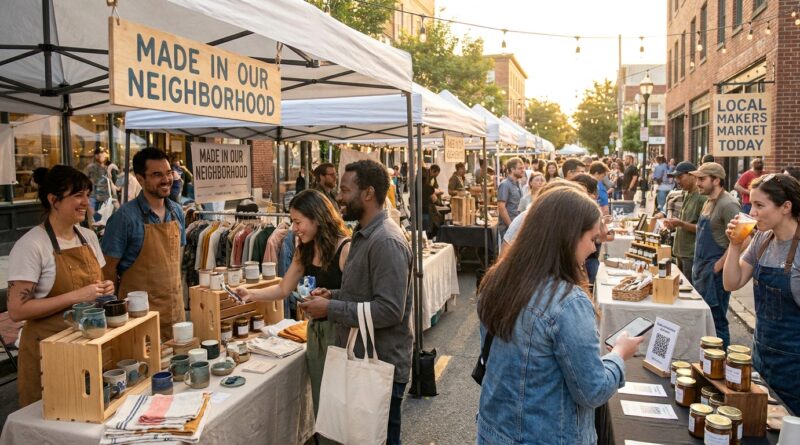
The Hyper-Local Maker Market Boom: How Neighborhood Fairs Are Quietly Turning Side Hustles Into Serious Manufacturing
You can spend all week making something excellent, then spend Saturday watching people smile at your booth like it is a school fundraiser. That gets old fast. A lot of serious makers know this feeling. Your work is solid. Your process is real. Your customers are interested. But the market around you still treats handmade goods like a charming extra, not the start of real local manufacturing.
Here is the shift most people are missing. The hyper local maker market is not just a weekend event anymore. In many towns, it is becoming a testing ground for small batch production, retail partnerships, youth training, repair culture, and city backed business growth. If you show up like a hobby seller, you blend in. If you show up like a manufacturer with a clear product line, pricing, story, and repeatable process, these markets can become your first sales channel, your focus group, and your launchpad.
⚡ In a Hurry? Key Takeaways
- Hyper local maker markets are growing into real business ecosystems, not just casual craft fairs.
- Start presenting yourself as a small manufacturer with repeatable products, clear pricing, and wholesale-ready information.
- The biggest value is not one day of sales. It is local demand, retail contacts, and keeping money circulating in your neighborhood.
The market table is not the business. It is the showroom.
This is the first mindset shift that matters.
Too many makers treat the event itself as the whole opportunity. Set up table. Sell what you can. Pack up. Hope next month is better. That approach keeps you trapped in one-off transactions.
A stronger approach is to treat the hyper local maker market as your live demo space. It is where you test products, watch what people pick up first, hear what they ask, and learn what they will actually pay for.
If three people ask whether your candle comes in a larger size, that is product feedback. If a local shop owner asks about consistent restocks, that is not a compliment. That is a lead.
Why these neighborhood markets are changing
Something bigger is happening behind the folding tables and coffee carts.
Across the country, neighborhood fairs and maker events are getting more organized. Cities are backing small business corridors. Community groups are creating retail incubators. Event organizers are curating vendors more carefully. Some are adding youth maker programs, workshops, and shared production resources.
That matters because it changes the role of the event. A market used to be a place to sell a few pieces on a Saturday. Now it can also be a place to get discovered by local retailers, connect with economic development groups, and build a customer base that wants to buy from someone nearby.
It also connects with the same values behind the repair movement. People are getting tired of disposable stuff and faceless brands. That is one reason articles like The Hyper-Local Repair Room Revival: How Neighborhood Fixers Are Quietly Outshining Throwaway Culture are resonating. Buyers want things made well, made nearby, and made by people they can actually meet.
How to show up like a manufacturer, not just a vendor
Build a focused product line
If your table has twenty unrelated ideas, people read it as a hobby. If your table has a tight line of products with a clear point of view, people read it as a business.
That does not mean boring. It means coherent.
Maybe you make home goods from reclaimed wood. Maybe you produce small batch skin care for sensitive skin. Maybe you sew durable work aprons for gardeners, barbers, or ceramic artists. Give people a quick way to understand what you make and who it is for.
Use simple signage that explains the process
Most customers do not know what goes into making a product. Help them.
Use signs that answer basic questions fast:
- What is it made from?
- Where is it made?
- Why is it different?
- Can they buy it again later?
Good signage turns curiosity into confidence. Confidence turns into sales.
Price for repeatability
A lot of makers underprice because they are comparing themselves to hobby sellers or trying to compete with big box pricing. That is a dead end.
If your prices only work when you ignore your labor, packaging, setup time, payment fees, and transportation, you do not have a business. You have an expensive weekend habit.
Price so you can make the item again. Price so you can grow. Price so a future retail partner does not laugh when you try to explain your margins.
Collect customer information
If someone loves your product and walks away without buying, that should not be the end of the relationship.
Use a simple email signup, QR code, or text list. Offer restock alerts, event dates, or preorders. This is how one market buyer becomes a repeat customer.
What event organizers and local programs are actually looking for
Here is the good news. More organizers want dependable makers who can grow with the event.
They are often looking for people who:
- Have a clear product category
- Can keep inventory consistent
- Present professionally
- Fit the event’s mission around local production
- Can join workshops, panels, or youth demonstrations
That last one is important. If you can talk about your process, teach a simple skill, or explain how production works on a small scale, you become more valuable than a seller with pretty packaging and no real story.
Signs your neighborhood fair may be a real growth channel
Not every market is worth your time. Some are still random, underpromoted, or badly matched to your product. Others are quietly becoming serious pipelines.
Look for these clues
- The event is curated, not just first come first served
- There is a waiting list or vendor standards
- Local shops, nonprofits, or city programs are involved
- The audience matches your ideal customer
- There are press mentions, partnerships, or educational programming
- Vendors come back because they build real relationships there
If you see those signals, pay attention. That market may be part of a bigger local economic engine.
Turn local demand into something bigger
The smartest makers do not stop at direct sales.
They use the hyper local maker market to answer bigger questions. Which product should be produced in larger batches? Which price point moves fastest? Which packaging gets picked up most often? Which neighborhoods respond best?
That information is gold. Big brands spend heavily to get data like that. You can gather it face to face in your own backyard.
And once you have it, you can start making better business decisions. You can tighten your line, plan production, approach stores, launch seasonal runs, or open preorder windows with more confidence.
Common mistakes that keep makers looking small
Too much custom work
Custom orders can feel flattering, but they can wreck your workflow. Keep some room for custom requests if they fit your model. Just do not let them replace your repeatable core products.
No follow-up system
If a buyer has to remember your Instagram handle from memory next week, you lost the chance.
Weak booth flow
If people cannot tell where to look first, they often keep walking. Put your strongest product front and center. Make pricing visible. Make checkout easy.
No business materials
Bring a line sheet, business cards, wholesale basics, and a short version of your story. You never know when a local buyer, event producer, or city program manager will stop by.
Think neighborhood first, platform second
Online platforms still matter. Of course they do. But too many makers build for algorithms before they build for neighbors.
That can flip your priorities in the wrong direction. You end up chasing reach instead of building resilience.
Local markets give you something online platforms rarely do. Immediate trust. Real conversations. Community memory. People remember the person who made the thing, not just the product photo.
And when more neighborhood spending stays local, more neighborhood capacity grows with it. That means more makers, more repair people, more small production spaces, and more reasons for customers to buy nearby again.
At a Glance: Comparison
| Feature/Aspect | Details | Verdict |
|---|---|---|
| Casual vendor mindset | One-off sales, mixed products, little follow-up, pricing based on guesswork | Fine for testing, weak for long-term growth |
| Manufacturer mindset | Focused line, repeatable production, clear margins, customer capture, retail readiness | Best path to turning market demand into a real business |
| Strong hyper local maker market | Curated vendors, community backing, workshops, partnerships, local buyer traffic | Worth investing in as a growth channel |
Conclusion
The big shift is simple. Hyper local markets are no longer just cute community events. More of them are becoming structured ecosystems for small scale manufacturing, with youth programming, retail incubators, and city backed support that are actively looking for serious local makers. If you start showing up like a manufacturer instead of just a vendor, you can plug into that momentum now. That means better feedback, stronger local demand, more repeat customers, and more money staying in the neighborhood instead of flowing out to distant platforms and faceless brands. Your booth may look small. What it represents does not have to be.