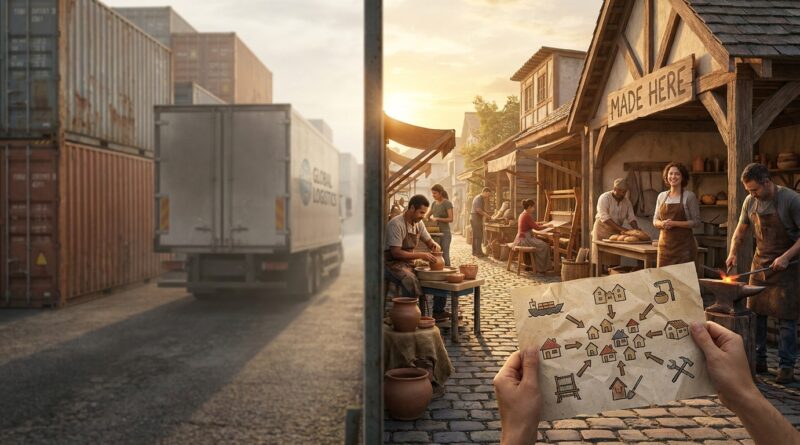
The Hyper-Local Supply Chain Swap: How Neighborhood Makers Are Quietly Replacing Global Logistics One Block At A Time
You keep hearing about supply chain chaos, yet somehow the answer always seems to be, “Wait longer and pay more.” That gets old fast. Especially when your neighborhood probably already has people making soap, baking bread, sewing aprons, roasting coffee, repairing lamps, printing signs, or building shelves a few blocks away. The problem is not that local skill disappeared. It is that it is scattered. One maker is selling at a Saturday market. Another is buried in Instagram posts. Another is taking orders by text from a church parking lot pickup table. A hyper local supply chain starts when buyers stop assuming everything has to come from a warehouse two states away and start connecting with the people already producing nearby. You do not need to replace your whole shopping cart overnight. Swapping even one or two repeat purchases to local sources can make your household a little more resilient and your block a little stronger.
⚡ In a Hurry? Key Takeaways
- A hyper local supply chain means buying a few everyday goods or services from nearby makers instead of relying only on distant mass suppliers.
- Start with products you buy often, like bread, gifts, cleaning goods, repairs, or basic home items, then build a simple neighborhood source list.
- Local does not always mean cheaper, but it can mean faster access, better quality, easier communication, and more money staying in your community.
What a hyper local supply chain actually means
Big supply chains are built for scale. They are very good at moving huge volumes across oceans, ports, rail yards, and highways. They are less good at feeling personal, staying flexible during disruptions, or helping your neighborhood earn a living.
A hyper local supply chain is much smaller and much closer to home. Think neighborhood bakers, metal workers, tailors, refill shops, woodworkers, small farms, repair techs, and home-based producers. They may not replace every global product. That is fine. The goal is not perfection. The goal is to reduce dependence where you realistically can.
That might mean buying birthday candles from a local maker, ordering office snacks from a neighborhood bakery, getting shelving built by a nearby carpenter, or using a local print shop instead of a faceless online seller.
Why this matters now
When prices jump or shelves look unpredictable, most people feel stuck. You still need the thing. You still have to pay. But nearby communities often already have the skills to cover part of that gap.
The issue is visibility. Local makers are often invisible unless you happen to walk by their stall, know their cousin, or catch a social post before it disappears. Meanwhile, large online stores are designed to be easy, fast, and always in front of you.
That is why the hyper local supply chain matters. It is less about making a grand statement and more about building a backup plan that also happens to support your local economy.
What kinds of products are easiest to swap first
Do not start with everything. Start with the things that are repeated, simple, and close to home.
Good first swaps
These are usually the easiest categories:
- Bread, pastries, preserves, and pantry basics
- Soap, candles, and simple household goods
- Gifts, cards, ceramics, and seasonal items
- Furniture, shelving, planters, and wood goods
- Alterations, mending, sharpening, and repairs
- Coffee roasting, spice blends, and specialty foods
Notice something here. Services count too. A local repairer is part of a supply chain because fixing what you already own can replace the need to order a new item from far away. That fits neatly with The Hyper-Local Repair Room Revival: How Neighborhood Fixers Are Quietly Outshining Throwaway Culture, which shows how nearby fixers can quietly reduce waste and cut replacement costs.
How to build your own neighborhood source list this week
This is where the idea becomes useful instead of just sounding nice.
Step 1: Pick three things you buy often
Do not make this harder than it needs to be. Pick three recurring items from your life. Maybe sandwich bread, birthday gifts, and clothing repairs. Maybe office coffee, hand soap, and plant pots.
Step 2: Search by place, not just by product
Instead of typing only the item name, search with your neighborhood, your zip code, nearby markets, school fundraisers, maker fairs, and community groups. Check bulletin boards, local Facebook groups, community newsletters, libraries, and small business directories.
Step 3: Ask one useful question
When you find a maker, ask, “Do you make this regularly, and how do repeat orders work?”
That question matters because the missing piece is often not talent. It is consistency. If a local producer has a clear reorder system, pickup time, and payment method, they become much easier to use again.
Step 4: Keep a short list
Make a simple note in your phone:
- Product
- Maker name
- How to order
- Pickup or delivery days
- Price range
That little list is your personal hyper local supply chain map.
What buyers usually get wrong
People often assume local means inconvenient, expensive, or limited. Sometimes it can be. But not always.
Local can also mean:
- Shorter wait times
- Custom sizes or small-batch options
- Direct contact with the person making the item
- Fewer surprise substitutions
- Easier problem solving if something goes wrong
The biggest mistake is comparing a neighborhood maker to a giant global retailer on every metric. That is not the right test. The better test is this: does the local option solve your need well enough, at a fair price, with less distance and more community benefit?
What makers need if they want to plug into real demand
This works better when local producers make themselves easier to find and easier to buy from.
Three basics matter most
- Clear product list
- Simple pricing
- Easy reorder instructions
A maker does not need a fancy ecommerce empire. But they do need a steady way for people to answer basic questions. What do you sell? How much is it? When can I get it?
If you are a maker, one page with photos, prices, pickup times, and contact info can do a lot of work. So can a standing weekly order form. So can joining forces with two or three other nearby producers for one pickup window.
How neighborhoods can connect the dots faster
One person shopping local helps. A group makes a real difference.
Here are a few ways communities can make a hyper local supply chain easier to use:
- Create a shared maker directory by block, school, or neighborhood
- Run a monthly local goods pickup day
- Bundle products, like bread plus jam plus coffee
- Use apartment lobbies, churches, or cafes as pickup points
- Ask offices and schools to source small recurring items locally
This is often how quiet change starts. Not with a giant policy shift, but with better coordination. One spreadsheet. One bulletin board. One neighborhood newsletter with names people can actually use.
Where hyper local works best, and where it does not
It helps to be realistic. A hyper local supply chain is not going to replace complex electronics manufacturing tomorrow. It is not meant to.
Where it works well
- Low to medium complexity goods
- Custom or handmade items
- Perishables and fresh goods
- Repairs and maintenance
- Small-batch business supplies
Where it is harder
- Mass-produced commodity items
- Highly regulated products
- Items requiring specialized industrial inputs
- Ultra-low-cost goods where scale dominates price
That is not failure. That is just being practical. The win comes from replacing what you can, not from pretending local can do every job equally well.
Why this can stabilize neighborhood income
When money is spent with a nearby maker, more of it tends to stay nearby. That can mean a local supplier buying from another local supplier, paying a neighborhood helper, renting nearby space, or spending profits at other local businesses.
It also gives micro producers a better shot at stable demand. A lot of talented people are not struggling because they lack skill. They are struggling because orders are random and hard to predict.
Even a small shift matters. Ten households buying one repeat item locally each month can do more for a tiny business than a hundred social media likes.
At a Glance: Comparison
| Feature/Aspect | Details | Verdict |
|---|---|---|
| Convenience | Global retail is often faster to find in one click, but local can be just as smooth once you have a short list of trusted nearby sources. | Local wins after setup |
| Price and value | Some local goods cost more upfront, but can offer better quality, custom fit, repair access, and fewer shipping surprises. | Case by case, often better long-term value |
| Community impact | Buying nearby helps neighborhood income circulate, makes local skills visible, and creates a fallback when big supply chains wobble. | Strong local advantage |
Conclusion
The good news is that a hyper local supply chain does not require a revolution, a grant program, or a total lifestyle overhaul. It can start with bread instead of shipped snacks. A repaired lamp instead of a replacement. A locally made gift instead of something rushed from a giant warehouse. Right now communities are watching prices climb and shelves shuffle while sitting on a quiet army of nearby makers, repairers, and micro producers who could step in if someone simply connected the dots. Swap one or two products this week. Save the contact. Reorder once. That is how neighborhood income gets steadier, money stays on the block a little longer, and resilience stops being an abstract idea and becomes something you can actually see on your street.