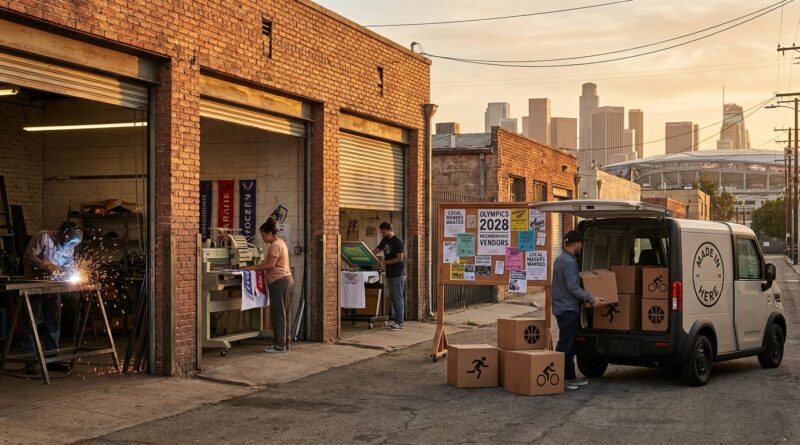
The Hyper‑Local Olympic Hustle: How LA Homegrown Makers Are Gearing Up For 2028 (And How Your City Can Copy It)
If you run a small shop, studio, bakery, print house, metal shop, or cut-and-sew operation, you have probably heard a lot of big talk about “bringing manufacturing back” and felt one very practical question nagging at you. Great. But where do I fit? That frustration is real. Cities love ribbon cuttings and giant factory headlines. Meanwhile, the neighborhood maker is still trying to figure out who buys local, what counts as “made here,” and how to get past paperwork that seems built for giant vendors. That is why Los Angeles is worth watching right now. As the city gears up for the 2028 Olympics, it is starting to bake small, local, and even hyper-local suppliers into procurement planning. At the same time, new rules and tools around “Made in USA” claims mean proof matters more than clever marketing. Put those two trends together, and a real opening appears for smaller businesses that can show both local value and clear origin.
⚡ In a Hurry? Key Takeaways
- LA28 is creating real hyper local manufacturing opportunities through procurement, but small makers need to get visible and get their paperwork in order early.
- Start by treating your city’s stadiums, hospitals, universities, festivals, and transit projects like mini-Olympics, then build a local supplier pitch around them.
- “Made in USA” claims now need proof, not vibes. Keep records on sourcing, labor, and final assembly so bigger competitors do not win just because they look more organized.
Why LA’s Olympic build-up matters to regular local businesses
When people hear “Olympics procurement,” they often picture giant construction firms, security contractors, or multinational sponsors. That is part of the story, but not all of it.
Big events need thousands of smaller things too. Uniforms. Signage. Branded merchandise. Catering inputs. Furniture. Fixtures. Temporary structures. Packaging. Repair services. Event decor. Metal fabrication. Print runs. Soft goods. Wayfinding materials. Local food products. Gifts for delegates. Set pieces. Cleaning supplies. Storage systems.
That is where local makers can fit.
The search term here is not just Olympic business. It is hyper local manufacturing opportunities LA28 Olympics procurement. Hyper-local means close enough that your location itself becomes part of the value. You can deliver fast. You can customize. You can fix issues in person. You can show buyers your workshop. You can tell a credible local story.
For buyers under pressure, that matters more than many small businesses realize.
What “hyper-local” really means in plain English
Local is often used loosely. Hyper-local is more specific.
It is not just “made somewhere in America”
A product can be made in the U.S. and still feel far away from the event or institution buying it. Hyper-local means the maker is rooted in the same city or region as the customer.
It turns distance into an advantage
If a school district, sports venue, or organizing committee needs a change by Friday, the shop down the road has an obvious edge over a supplier three states away.
It gives buyers a story they can defend
Procurement teams now face pressure from city leaders, the public, labor groups, and community organizations. Buying from nearby businesses can help them show local impact, not just low cost.
Why proof of origin suddenly matters a lot
This is the less glamorous part, but it may decide who wins.
For years, plenty of companies used “Made in USA” language pretty loosely. That is getting harder. Regulators, retailers, and verification companies are pushing for clearer standards and better documentation. If you say your goods are American-made, or locally produced, you may need to show receipts, production records, supplier lists, and assembly details.
That sounds annoying. It is. But it is also a chance.
Small businesses often assume paperwork favors the big guys. Sometimes it does. But if your operation is truly local, your story may actually be easier to prove. You know who cuts, bakes, welds, sews, prints, packs, and ships the thing. You can often trace it faster than a large company juggling many vendors.
How LA makers can get boxed out, even when they are the best fit
Here is the trap.
A local business may have the right product, fair prices, and a strong community story, yet still lose because a larger incumbent has better forms, cleaner compliance files, and a person whose full-time job is answering procurement questions.
That is why this moment is not just about making good stuff. It is about making your business easy to buy from.
Common weak spots for small makers
Many neighborhood businesses get stuck in the same places:
- No capability statement or one-page company summary
- No clear list of production capacity or lead times
- No documentation for where materials come from
- No insurance or outdated insurance certificates
- No system for invoices, purchase orders, or vendor onboarding forms
- No clear answer to “How much can you scale if demand spikes?”
None of this is exciting. All of it is important.
What smart small businesses should do now, not in 2028
If you wait until Olympic contracts are public and crowded, you are late. Relationships and approved vendor lists often take shape well before the spotlight hits.
1. Build a simple “buy local from us” packet
This can be a two-page PDF. Keep it plain and useful.
- What you make
- Where you make it
- Who does the work
- How much you can produce per week or month
- Your average turnaround time
- Past clients or sample projects
- Certifications, licenses, insurance, and contact details
Think of it as your business in buyer language, not maker language.
2. Create an origin-proof folder
Do not overcomplicate this. Start a digital folder with:
- Supplier invoices
- Bills of materials
- Photos of production
- Payroll or staffing records that show where work happens
- Assembly steps
- Packaging details
If someone asks, “Can you back up your claim?” you want an answer in minutes, not weeks.
3. Register anywhere serious buyers look
That can include city vendor databases, county procurement lists, chamber directories, manufacturing alliances, and local business supplier portals. The exact list varies by region, but the idea is the same. If buyers cannot find you, they cannot invite you.
4. Start with subcontracting, not just prime contracts
You do not always need to win the giant contract yourself. A lot of money flows through larger firms that need local partners for fulfillment, customization, rush work, and community compliance goals.
5. Practice your answer to “Why you?”
Keep it short: “We make this in Los Angeles, with local labor, short lead times, and documented sourcing. We can deliver custom runs fast and fix issues on-site.”
How your city can copy LA without hosting the Olympics
This is the part many readers can use right away.
Your city does not need the Olympics to create hyper-local demand. It just needs anchors.
Think in “bite-size Olympics”
Look for large, recurring, or high-visibility buyers that need many things from many vendors. Examples:
- Universities
- Hospital systems
- Airport upgrades
- Convention centers
- Sports arenas
- Music festivals
- Marathons and tourism events
- Transit expansions
- School district programs
- Downtown revitalization projects
Each one can act like a mini procurement engine.
Map demand before you pitch
Do not start with “We make cool stuff.” Start with “Here are the 12 things this event or institution buys every year that could be sourced locally.”
If you are a textile shop, think uniforms, banners, tote bags, table linens, soft signage, and VIP gifts. If you are a metalworker, think brackets, display structures, railings, fixtures, mounts, and repair fabrication. If you are a bakery, think hospitality boxes, branded edible gifts, and recurring event supply.
Organize with other small makers
One tiny shop may not meet capacity alone. Five can.
That is where local networks matter. Shared quoting. Shared production overflow. Shared logistics. Shared paperwork templates. Buyers like one reliable point of contact. A local cluster can act bigger than any one member.
What buyers actually want from a local supplier
Here is some good news. Most buyers are not expecting a tiny maker to look like a giant corporation. They are usually looking for confidence.
They want reliability
Can you deliver when you say you will?
They want traceability
Can you show where the product came from and where it was made?
They want low drama
Can you fill out forms, carry insurance, and respond quickly?
They want a local story that holds up
If they put your name in a press release, will it stand up to scrutiny?
This is why hyper-local businesses can be so appealing. They can often offer all four, if they prepare.
Simple examples of where neighborhood makers can win
Bakeries and food producers
Hospitality packs, media-event treats, athlete village specialty items, sponsor gifts, and conference catering extras. Local food stories are easy for buyers to understand and easy for the public to appreciate.
Metal and wood shops
Temporary displays, podium elements, branded installations, custom brackets, repair work, and short-run fixtures. Speed and custom fabrication can beat cheaper distant vendors.
Textile and apparel businesses
Staff gear, event merchandise, patches, bags, banners, and accessories. This is especially strong if you can prove domestic cutting, sewing, and finishing.
Printers and packaging shops
Wayfinding, wraps, inserts, labels, event folders, presentation kits, and local product packaging. Procurement teams often need rush turnarounds here.
Do not confuse “local” with “automatic win”
This is where I want to be careful. Being nearby helps. It does not erase cost pressure, compliance requirements, or competition.
Some buyers still default to giant vendors because it feels safer. Others will split contracts in ways that make it hard for smaller firms to participate. Some local preference language sounds great in public and then gets watered down in practice.
So go in with open eyes.
Your edge is not just proximity. It is proximity plus proof plus professionalism.
A practical checklist for the next 30 days
If this trend fits your business, here is a sane way to start.
- Make a one-page capability sheet
- List your production capacity and rush capacity
- Gather supplier invoices and material origin info
- Take photos of your production process
- Check your insurance and business licenses
- Register in at least two buyer-facing directories or portals
- Identify three local anchors in your city
- Write one tailored pitch for each anchor
- Find one larger contractor you could support as a local subcontractor
- Create a short email that explains what you make, where you make it, and why that matters
That is not a full procurement strategy. But it gets you out of “we should probably look into this someday” mode.
At a Glance: Comparison
| Feature/Aspect | Details | Verdict |
|---|---|---|
| Big-event demand | LA28-style procurement can create demand for everything from uniforms and signage to food, fixtures, and branded goods. | Real opportunity, if you get in early. |
| Origin verification | “Made in USA” and local-made claims are getting more scrutiny, which rewards businesses with clean records and traceable sourcing. | A hassle, but also a strong advantage for honest local makers. |
| Small-business readiness | Many makers have the skills but not the paperwork, vendor registration, or buyer-friendly materials needed to compete. | Fixable now, and worth doing before contracts harden. |
Conclusion
What is happening around LA28 is bigger than one sporting event. It is a preview of how cities can steer spending toward nearby businesses, while tougher “Made in USA” standards push everyone to prove what they claim. That mix is where small and hyper-local makers can do very well. Not by shouting louder than giant suppliers, but by being easier to trust. If you can show what you make, where you make it, how fast you can deliver, and why your local presence helps the buyer, you stop looking like a small backup option and start looking like the smart pick. The important thing is timing. These systems, vendor lists, and verification habits are being set now, not the week before opening ceremonies. Move early, get your proof together, and your city’s next “mini Olympics” could become your biggest contract pipeline yet.