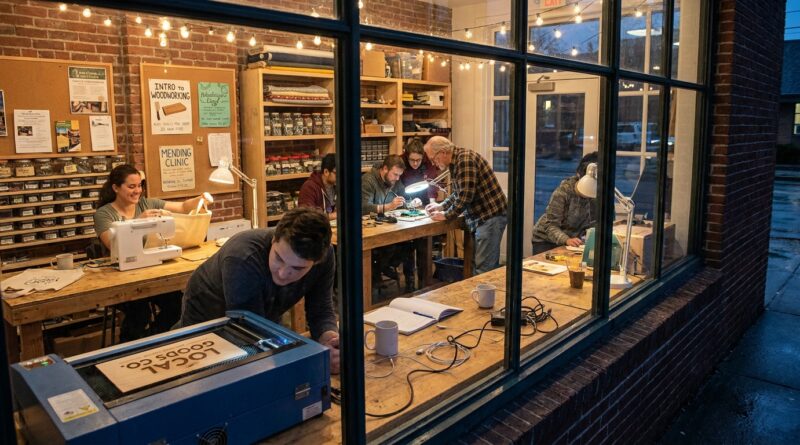
The Hyper-Local After-Hours Lab: How Community Makerspaces Are Quietly Becoming Night Schools For Neighborhood Skills
You can only watch so many how-to videos before the itch gets annoying. You want to fix the chair, make the sign, sew the sample, build the shelf, maybe even test a product idea. Then reality shows up. Night classes can be pricey. Community college schedules do not always fit work and family. And the local makerspace, if you have one, can look like a club for people who already know what every tool does. That hesitation is real. The good news is that many community makerspace night classes are much more welcoming than they seem. Across the country, these spaces are quietly turning into neighborhood night schools, with short evening workshops, beginner tool training, and open lab hours that let regular people learn useful skills a little at a time. You do not need to quit your job, buy expensive gear, or call yourself a maker to walk in and start.
⚡ In a Hurry? Key Takeaways
- Community makerspace night classes are becoming practical, affordable ways to learn real skills close to home.
- Start with a beginner workshop or tool safety session, not a big project. One two-hour class is enough to get moving.
- These spaces can save money and reduce risk because you learn on shared equipment with guidance before buying your own tools.
Why This Matters Right Now
People are hungry for skills that feel useful in real life. Not abstract. Not someday. Useful now.
Maybe it is learning to repair a lamp instead of tossing it. Maybe it is making packaging for a side business. Maybe it is figuring out whether a product idea works before spending thousands on tools and inventory.
That is where community makerspace night classes fit so well. They usually happen after work, they tend to be shorter than formal semester courses, and they connect directly to everyday needs. You are not studying for a grade. You are learning to do something with your hands, your brain, and your neighborhood.
This is also part of a bigger local learning shift. If you have noticed more small creative workshops popping up, you are not imagining it. The Hyper-Local Class Boom: How Neighborhood Hobby Schools Are Turning Makers Into Micro-Businesses gets at the same idea from another angle. People want classes that lead somewhere tangible.
What a Makerspace Actually Is
If the word sounds a little vague, think of a makerspace as a shared workshop. Sometimes it is focused on wood and metal. Sometimes it leans toward sewing, printmaking, electronics, or digital fabrication like laser cutters and 3D printers. Often it is a mix.
The key point is simple. Instead of every person buying every tool, the community shares access to equipment, workspace, and training.
Common things you might find inside
Depending on the space, you may see:
- Laser cutters for signs, prototypes, and custom pieces
- 3D printers for product mockups and replacement parts
- Sewing machines and sergers for textiles and small product runs
- Woodworking tools for furniture, shelves, and repair
- Electronics benches for soldering and small device projects
- Open craft tables for assembly, finishing, and group work
That can sound intimidating on paper. In practice, most beginners start small. A one-night intro to vinyl cutting. A two-hour sewing basics class. A safety check on the laser cutter. Nobody expects you to master everything at once.
Why These Spaces Feel More Useful Than Traditional Night Classes
Traditional classes can be great. But they often ask for more time, more money, and more commitment up front. Makerspaces flip that a bit.
Shorter commitment
Many workshops run one evening or over a few weeks. That means you can test your interest without signing up for a full term.
Immediate payoff
You leave with something. A repaired item. A printed sample. A wooden box. A first prototype. That matters when motivation is fragile.
Local context
These classes often attract neighbors solving neighbor-sized problems. A food business owner making market signage. A parent fixing a stroller part. A teen learning CAD. A retiree finally trying woodworking. The projects make sense because they come from local life.
Less pressure
You are not there to impress anyone. You are there to learn enough to try the next thing. That is a much easier way in.
What You Can Learn in Just a Couple Hours a Week
This is the quiet magic of the model. You do not need endless free time.
Two hours a week over a month can get you surprisingly far if the teaching is hands-on and focused. For example:
- Learn basic laser cutting and make branded signs or packaging inserts
- Pick up sewing fundamentals and stitch a first product sample
- Use 3D modeling software to test a local hardware idea
- Get comfortable with repair skills for bikes, lamps, furniture, or small appliances
- Try screen printing, woodworking, or bookbinding without buying a full setup
That is why the night school comparison fits. It is not school in the stiff, fluorescent-light sense. It is school in the useful, neighborly, after-hours sense.
How To Get Past the “This Place Is Not for Me” Feeling
Let’s be honest. Some makerspaces do a poor job with first impressions. You walk in and see half-finished robots, industrial tools, and people tossing around terms you do not know. It can feel like showing up late to a party where everyone already knows each other.
Do not judge the place by the loudest project in the room.
Start with these low-stress entry points
- Beginner orientation nights
- Tool safety classes
- Women’s, family, or first-timer workshop sessions
- Open houses with demos
- Repair cafes or community fix-it events
These formats are designed for people who are curious, not expert. If a space does not offer anything like that, ask. The answer tells you a lot about whether they really want new people in the door.
How To Pick the Right Community Makerspace Night Classes
Not every class will be worth your time. A little filtering helps.
Look for a clear outcome
A good listing tells you what you will make, what you will learn, and what level it is for. “Intro to Laser Cutting: Make a Custom Sign” is better than “Digital Fabrication Night.”
Check tool access after class
The best value comes when a workshop unlocks future use of the equipment. If you take the laser cutter class, can you book laser time later? If yes, that is a strong sign.
Ask what is included
Materials, safety gear, software access, and follow-up lab time can change the real cost a lot.
Read the room
Look at photos, social posts, and event listings. Do you see beginners? Small business owners? Kids and adults? Community events? A healthy mix usually means the culture is more open.
Who Benefits Most
The obvious answer is hobbyists. But that is only part of the story.
Side hustlers and small businesses
If you need one sign, ten sewn samples, or a quick prototype, a makerspace can be a smart bridge between idea and investment.
Career changers
Thinking about trades, fabrication, design, or product work? A few night classes can tell you whether the work actually clicks before you commit to a larger program.
Families and neighbors
These spaces can become community anchors. People meet. Skills spread. Confidence grows. One person learns to fix a thing, then helps three more.
People who are tired of only consuming
There is a deep satisfaction in making something useful instead of just buying another version of it online. That feeling is hard to fake.
The Real Economic Value, Not Just the Fun Part
Makerspaces are often described as creative hubs, which is true, but a little soft around the edges. They can also be practical local infrastructure.
Think about what happens when residents can prototype products nearby, make first batches locally, repair things instead of replacing them, and test ideas without huge startup costs. Money stays closer to home. Skills stay in the neighborhood. More people get a shot at trying something.
That could mean a family shop gets affordable custom signage. A local vendor creates packaging in-house. A neighborhood inventor builds version one instead of letting the idea die in a notebook.
That is not hype. It is a modest, realistic kind of economic development. One class, one tool certification, one small project at a time.
Safety and Common Sense Still Matter
This is the grown-up part of the conversation. Shared tools are great. Shared tools can also hurt you if the culture is sloppy.
Green flags
- Required safety training before tool access
- Staff or volunteers visible during open lab time
- Clear signage and clean work areas
- Age policies and supervision rules that make sense
- Simple booking and check-in systems for equipment
Red flags
- No orientation process
- People using serious tools without oversight
- Broken equipment left out
- Confusing rules that only insiders seem to understand
You want a place that feels friendly, not casual about safety.
How To Start Without Overthinking It
If you are curious, here is the easiest path.
Your first three steps
- Search for beginner-friendly community makerspace night classes in your area.
- Pick one class with a concrete project and a clear beginner label.
- Go once before deciding whether you are “the kind of person” who belongs there.
That last part is important. Belonging usually comes after showing up, not before.
Good first classes to try
- Intro to sewing
- Laser cutter basics
- 3D printing for beginners
- Furniture repair or fix-it nights
- Screen printing or sign making
These tend to offer quick wins and do not require a huge technical ramp.
At a Glance: Comparison
| Feature/Aspect | Details | Verdict |
|---|---|---|
| Cost and access | Usually cheaper than buying your own tools and often less expensive than long formal courses, especially when materials and equipment are included. | Strong value for trying skills before making a bigger investment. |
| Skill building | Short evening workshops teach practical fabrication, repair, craft, and prototyping skills with immediate hands-on use. | Best for learning by doing, not just listening. |
| Community fit | Brings neighbors, side hustlers, and curious beginners into the same shared lab, though culture varies by space. | Excellent when the space offers beginner pathways and a welcoming tone. |
Conclusion
There is a reason this idea is catching on quietly. People want real-world skills, but they do not always want the cost, distance, or formality of traditional night classes. Community makerspace night classes meet people where they are. A couple hours after work. A practical project. Shared tools. Real guidance. A path from “I wish I knew how” to “I made this.” Framed as neighborhood night schools, these spaces make a lot of sense. You can learn to laser cut a sign for your family shop, sew a first product batch, or prototype a local hardware idea without quitting your day job. That helps residents build confidence, helps underused community labs stay active, and helps local economies grow from the ground up. Sometimes the most useful school in town is the workshop down the street that stays open after dinner.