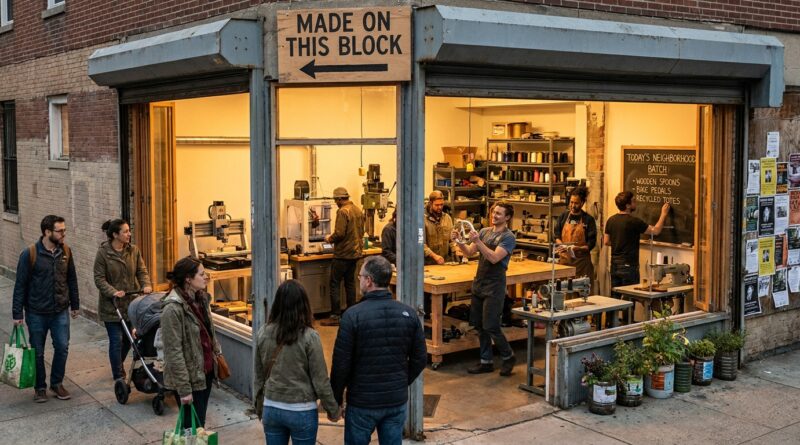
The Hyper-Local Porch Factory: How Tiny Neighborhood Micro‑Factories Are Quietly Rewiring Supply Chains Street By Street
You are not imagining it. It is strange to watch another headline about port backups, factory shutdowns, or shipping delays while your own neighborhood is full of empty storefronts, garage workshops, church kitchens, and skilled people who could be making useful things right now. That gap is what makes hyper local micro factory neighborhood manufacturing so interesting. This is not some sci-fi plan to put a giant plant on your block. It is a practical shift toward tiny production hubs that make small batches close to the people who will actually buy them. Think local apparel runs, custom shelves, refill products, packaged foods, repair parts, or school merch made a few streets away. The big idea is simple. Make less, waste less, ship less, and keep more money and know-how nearby. Once you see it that way, supply chains stop feeling like something that only happens overseas. They start looking a lot more like a neighborhood decision.
⚡ In a Hurry? Key Takeaways
- Hyper-local micro-factories are small neighborhood workshops that make goods on demand, closer to where people live.
- If you want to support one, start by buying local basics, joining maker spaces, or helping a local business test a tiny batch product.
- The real value is resilience. Shorter supply lines can cut shipping, overstock, and waste while keeping jobs and skills in the community.
What a porch factory really is
The phrase sounds cute, but the model is serious. A porch factory is not always literally on a porch. It is a very small production setup woven into everyday neighborhood life. It might be a converted storefront with laser cutters and sewing machines. It might be a shared commercial kitchen turning out pantry staples. It might be a woodworking studio making shelves, stools, and repair parts in batches of 10 instead of 10,000.
The point is scale. These businesses are not trying to beat a global mega-plant on price per unit. They are trying to win on speed, flexibility, customization, and low waste.
What they usually make
Hyper local micro factory neighborhood manufacturing works best for products that do not need giant industrial lines. Good examples include:
- Apparel and tote bags
- Candles, soaps, and refill products
- Small furniture and home goods
- Baked goods and shelf-stable food items
- Replacement parts, signs, and school or event merchandise
These are everyday products. Not novelty items. That is what makes the trend worth watching.
Why this matters now
Most people only think about supply chains when something breaks. The package is delayed. The replacement part is backordered. The store shelf is half empty. Then things calm down and we forget again.
Micro-factories offer a different way to think about the problem. Instead of asking, “How do we fix a giant global chain?” they ask, “What should never have needed a giant global chain in the first place?”
That mindset is catching on. If you liked the idea behind The Hyper-Local Micro‑Factory Next Door: How Tiny Neighborhood Workshops Are Quietly Replacing Container Ships, this is the same shift at street level. Less dependence on distant factories. More production where life is actually happening.
How neighborhood manufacturing becomes real
This is the part that usually gets fuzzy. People hear “local production” and picture either a craft fair or a giant subsidy plan. In reality, it often starts much smaller and more practically.
Step 1. Start with one repeatable product
The strongest micro-factories do not begin with a giant catalog. They start with one thing people already want. Maybe it is school uniforms, neighborhood-branded shirts, spice blends, ceramic planters, or flat-pack furniture for small apartments.
The trick is consistency. One useful item made well beats 30 experimental products nobody can reorder.
Step 2. Use compact tools and digital workflows
Small-batch manufacturing got easier because the tools got smaller and smarter. Desktop CNC machines, digital embroidery, 3D printers, laser cutters, compact food packaging lines, and online ordering systems all lower the barrier to entry.
You do not need a sprawling industrial park to make quality goods anymore. You need the right tool for the right product, plus a way to manage orders without chaos.
Step 3. Produce on demand or in tiny batches
This is one of the biggest changes. Traditional supply chains often guess what people will buy, make too much, ship it far away, then discount the leftovers. A neighborhood workshop can wait for real demand, or make only a very small batch to test interest.
That means less dead stock sitting in a back room. Less money tied up in inventory. Less waste when trends change.
Step 4. Stay close to the customer
Being nearby is not just a nice story for marketing. It changes how the business works. Customers can pick up orders. They can ask for small adjustments. Local shops can reorder quickly. Problems get spotted sooner.
That closeness is a competitive advantage, not a compromise.
What neighborhoods actually gain
It is easy to talk about resilience in abstract terms. Here is what it looks like on the ground.
Shorter delivery paths
If a cutting board, apron, or jar of sauce travels 2 miles instead of 2,000, that is less shipping cost, less packaging, and fewer chances for delay.
More visible local skills
Every neighborhood has hidden talent. Retired machinists. Hobby sewers. Bakers. Woodworkers. Graphic designers. Product photographers. Micro-factories give those skills a place to connect instead of staying scattered and invisible.
Income that circulates nearby
When a product is made locally, more of the money tends to stay local too. It pays the maker, the landlord, the nearby supplier, the local delivery person, and sometimes the local school or market that helped create the demand.
Faster adaptation
Need a run of custom tote bags for a school fundraiser next week? A micro-factory can often say yes. Need 50 shelves sized for small apartments instead of suburban houses? Same story. Small shops can pivot much faster than giant plants built for huge volume.
What this model does not fix
It helps to keep expectations sane. Hyper local micro factory neighborhood manufacturing is not going to replace every global supply chain. Your phone, refrigerator compressor, or car battery still depends on large-scale production.
But that does not make the idea small. It means the sweet spot is clear. Neighborhood manufacturing is best for useful goods that benefit from short runs, quick feedback, and low shipping distance.
It also needs support. Zoning rules, commercial rents, permits, insurance, and access to equipment can all get in the way. Good ideas still need practical room to operate.
How to support a micro-factory without starting one yourself
You do not need to buy industrial equipment or turn your garage into a workshop. Most people can help in simpler ways.
Buy boring things locally
Everyone says they want to support local makers, then only buys special gifts once a year. A better habit is buying regular-use items locally when possible. Cleaning refills. Bread. Printed tees. Shelves. Soap. School merch. Pet treats. Small home goods.
Routine spending is what makes local production sustainable.
Ask local shops where their goods come from
Sometimes demand needs a nudge. If enough customers ask whether a boutique, hardware store, or café carries locally made products, owners notice. They start testing small runs.
Join or back shared production spaces
Maker spaces, co-ops, kitchen incubators, and community workshops are often the on-ramp. They spread equipment costs across many people and make it much easier for a tiny business to start.
Think in orders, not just ideas
One of the best ways to help is to organize demand. A school, church, apartment building, or neighborhood group can place a small group order for aprons, signage, snacks, uniforms, or tote bags. That turns local enthusiasm into actual production.
If you want to start one, keep it humble
This is where many people get stuck. They imagine they need a perfect business plan, a warehouse, and a full product line. Usually, they do not.
Start with a narrow need. Figure out what your block, district, or town repeatedly buys. Then ask a simple question. Could a tiny local shop make that competitively enough to matter?
Sometimes the answer is yes because the local version is faster. Sometimes because it is customizable. Sometimes because people want fewer returns, less packaging, and a real person to talk to.
That is plenty. You do not have to rebuild all manufacturing. You just have to make one category make sense close to home.
At a Glance: Comparison
| Feature/Aspect | Details | Verdict |
|---|---|---|
| Speed and flexibility | Micro-factories can make small runs quickly, adjust designs fast, and respond to local demand without waiting for overseas shipping. | Best choice for custom, seasonal, or fast-turn items. |
| Cost per unit | Large factories usually win on raw unit cost at huge volume, but local shops can save money on storage, shipping, and unsold inventory. | Works well when total cost matters more than the cheapest sticker price. |
| Community value | Neighborhood manufacturing keeps skills visible, creates local income, and makes supply chains easier to understand and influence. | Strong long-term benefit for resilient local economies. |
Conclusion
Hyper-local production is not a fantasy fix for every supply problem. It is better than that. It is a practical, block-by-block way to make some of the things we use every day closer to home. A new generation of micro-factories is shifting production from distant mega-plants to compact neighborhood workshops that can make small batches on demand, cutting shipping, overstock, and waste while keeping income and skills nearby. That matters right now because resilience should not live only in policy papers and corporate strategy decks. It can live on your street too. Support the local maker. Ask where products come from. Help a small batch get its first order. That is how neighborhood manufacturing stops being a buzzword and starts becoming real.