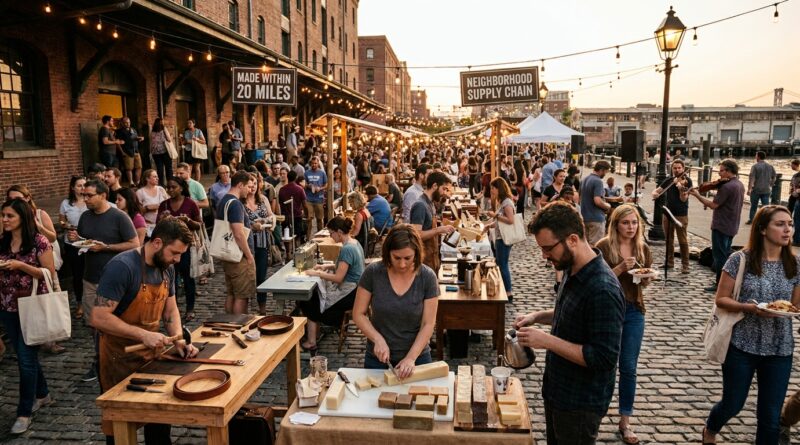
The Hyper-Local Night Market Boom: How Pop-Up Maker Streets Are Quietly Turning Weekends Into Neighborhood Supply Chains
You have probably seen the same loop a hundred times. Someone posts “shop small,” you mean to do it, then Saturday comes and you end up at the same chain store because finding real local makers feels weirdly hard. That frustration is real. Most people are not against buying local. They are against spending three hours jumping between Instagram Stories, city calendars, and half-updated Facebook event pages just to find one candle maker or bread baker. The good news is that a better system is already showing up in plain sight. Hyper local night market makers are turning weekend streets, public plazas, farm festivals, and old market halls into easy places to discover who actually makes things near you. These are not just cute events for browsing anymore. They are becoming practical neighborhood supply chains, where you can meet the person behind the product, ask questions, and start replacing a few routine purchases with goods made close to home.
⚡ In a Hurry? Key Takeaways
- Hyper local night market makers give you one of the easiest real-world ways to find trustworthy local producers fast.
- Go in with a short shopping list, ask each vendor what they make themselves, and save your favorites for repeat buying later.
- Buying even one weekly item locally made can keep more money, jobs, and skills in your community.
Why these markets matter now
There is a big difference between liking the idea of local shopping and actually doing it. The problem has always been access. Most small makers do not have giant ad budgets, polished websites, or shelf space at major retailers. They might sell from a shared kitchen, a backyard workshop, a small studio, or a rented booth once a week.
That is where night markets and maker streets change the game. They gather dozens of producers in one place. Instead of hunting across the internet, you can walk one block and compare soap, jam, ceramics, knives, hot sauce, leather goods, baked items, produce, textiles, and housewares in person.
For regular people, that makes these events less like entertainment and more like a local sourcing shortcut.
What a hyper-local market really is
Think of it as a temporary main street built for nearby production. Some markets happen in historic downtown corridors. Others pop up along waterfronts, in parking lots, under pavilions, at fairgrounds, or inside permanent public markets.
The best ones usually mix a few things together:
- Food producers
- Farm vendors
- Home goods makers
- Personal care brands
- Repair, craft, or specialty trade businesses
- Live demos or samples
That mix matters because it helps you build a realistic habit. You are not just buying a novelty mug once a year. You are spotting things you can actually buy again, like bread, sauces, coffee, body care, pantry staples, gifts, and household basics.
How to use hyper local night market makers as a discovery engine
Start with one category, not a total lifestyle makeover
You do not need to replace everything in your house with locally made products by Sunday night. That is how people burn out and go back to the big box store.
Pick one category you already buy often. Good starter categories include:
- Coffee or tea
- Bread or baked goods
- Soap or lotion
- Hot sauce, jam, or honey
- Candles
- Produce or eggs
If you can switch just one repeat purchase, you have already built a better local buying habit.
Ask the simplest useful question
You do not need an expert script. Just ask, “Do you make this yourself nearby?” That one question tells you a lot.
Most real makers are happy to explain where they produce, what they source locally, and how often they sell. You are not interrogating them. You are learning whether this is a reseller, a brand with local assembly, or a truly local producer.
Look for repeatability
The smartest buy at a market is not always the flashiest one. It is the product you can easily return to next week or next month. Before you buy, check:
- Do they sell at the same market regularly?
- Do they take custom or repeat orders?
- Do they offer local pickup or delivery?
- Are they stocked in a nearby public market or independent shop?
This is how a fun Saturday visit turns into an actual neighborhood supply chain for your household.
Save vendor info on the spot
Do not trust your memory. Take a photo of the booth sign. Grab a card. Save their Instagram or website while standing there. Make a note in your phone like “great sourdough, booth near fountain” or “best unscented soap for gifts.”
That tiny step saves you from doing the whole search again later.
What to buy first if you want the biggest local impact
Some items make more sense than others. If your goal is to keep spending close to home, focus on products that are either consumed regularly or often bought as gifts.
Best weekly-routine swaps
- Bread
- Seasonal produce
- Coffee beans
- Eggs
- Prepared foods and sauces
- Soap and skin care basics
Best occasional swaps
- Ceramics
- Candles
- Wood goods
- Textiles
- Jewelry
- Gift boxes
Weekly-routine items help local businesses stay alive between holiday seasons. Gift items help them during peak buying periods. Both matter.
How to tell the difference between a real local maker and a generic reseller
Not every booth at every market is making products nearby. That does not automatically make them bad. But if your goal is true local production, it helps to know what to look for.
Good signs
- The vendor can explain how and where the product is made
- Packaging includes a local city, neighborhood, or production site
- They talk comfortably about materials, process, and restocks
- They know what is seasonal and what is made to order
Possible red flags
- Vague answers about where products come from
- Huge amounts of identical inventory with no maker story
- Product categories that feel randomly mixed
- No contact info beyond a payment app
You do not need to be suspicious of everyone. Just stay curious.
These markets are connecting to bigger local ecosystems
One useful thing about maker markets is that they rarely exist alone. The same vendors often show up in farm stands, small groceries, public markets, brewery events, and neighborhood festivals. Once you find one good producer, they usually lead you to three more.
That is also why local food and drink spaces have become such strong connectors. If you want another example of how this works, read The Hyper-Local Taproom Shift: How Neighborhood Breweries Are Quietly Turning Local Ingredients Into Community Hubs. Breweries, like night markets, often act as social maps for nearby producers.
A simple plan for your next weekend
If you want to make this practical, do this:
- Find one night market, public market, or maker festival within a short drive.
- Bring a list with three things you actually need this week.
- Plan to buy just one of them locally.
- Ask two vendors where and how they make their goods.
- Save contact details for your favorite three booths.
- Follow up with one repeat purchase within a month.
That is enough. You are not trying to become a procurement officer for your household. You are just building a better default.
Why this matters beyond shopping
When people talk about reshoring, manufacturing revival, or stronger local economies, the conversation can get abstract fast. Most neighbors do not own a factory. They do not know a distributor. They cannot rewrite trade policy.
What they can do is choose where one slice of routine spending goes. A loaf of bread from a neighborhood baker. A bottle of sauce made twenty minutes away. A ceramic mug from a local studio. A refill order from the soap maker you met in person.
Those choices sound small because they are small. That is the point. Small, repeatable actions are what keep local businesses open long enough to hire, train, expand, and stick around.
At a Glance: Comparison
| Feature/Aspect | Details | Verdict |
|---|---|---|
| Discovery speed | A single market can introduce you to dozens of producers in one walk. | Much easier than searching scattered social feeds. |
| Trust and transparency | You can meet makers face to face, ask where items are made, and judge quality in person. | Best option for confident local buying. |
| Long-term value | Good markets help you build repeat buying habits for everyday goods, not just one-off treats. | Most useful when you focus on weekly staples first. |
Conclusion
Right now, cities across the country are quietly turning public spaces into open-air micro-factories and showrooms for local makers. Night markets in historic waterfront districts, food and farm festivals, and public markets with dozens of small producers under one roof are making local buying easier for regular people. These events are no longer just for browsing. They are becoming one of the most practical entry points into hyper-local manufacturing for neighbors who do not know anyone in “industry” but still want their spending to stay close to home. If you use hyper local night market makers as discovery engines, you can replace at least one mass-produced item in your weekly routine with something made within a short drive. That one swap may feel modest, but it is exactly how local doors stay open, local jobs stay local, and local skills stay rooted where you live.