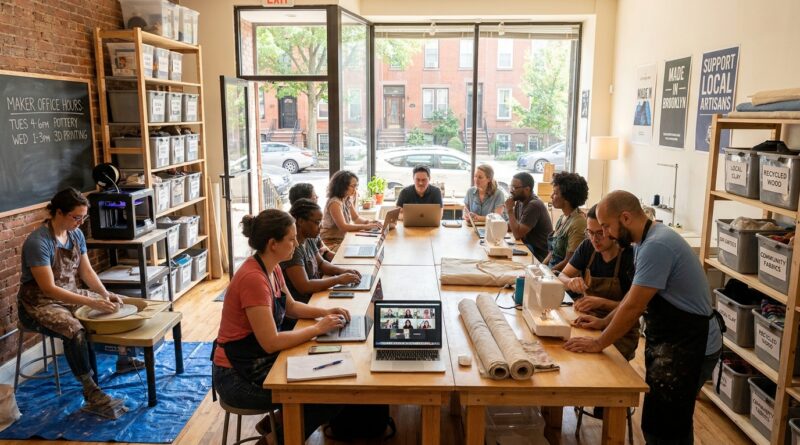
The Hyper-Local Office Shift: How Neighborhood Coworking Workshops Are Quietly Turning 9‑to‑5s Into Weekday Maker Hubs
If you have been taking meetings from the same kitchen table for two years, you are not imagining the slump. Home stops feeling like home when it is also the office, break room and conference booth. At the same time, plenty of local makers are doing beautiful work from garages, spare bedrooms and borrowed corners, but most neighbors never see it unless they stumble onto a weekend market. Those two problems fit together better than they look. A neighborhood coworking space for local makers can turn quiet weekday desks into a shared local hub. Remote workers get a real place to go and people to know. Makers get low-cost, visible space in a clean, central location. The result is simple but powerful. The person answering emails upstairs might become the person buying handmade mugs, hemmed pants or printed tote bags downstairs. That is not some big city master plan. It can start with one flexible workspace and a small pilot night.
⚡ In a Hurry? Key Takeaways
- A neighborhood coworking space for local makers can help remote workers feel less isolated while giving nearby makers affordable weekday visibility and workspace.
- Start small. Email one coworking manager and suggest a three-maker pilot evening or lunch-hour showcase before asking for a full program.
- Keep it safe and practical. Separate messy tools from desk areas, set clear insurance and access rules, and begin with low-risk crafts like textiles, ceramics display, prints or hand-finishing.
Why this idea is catching on quietly
Walk into a lot of coworking spaces on a Tuesday afternoon and you will notice the same thing. Nice tables. Decent coffee. Good Wi-Fi. A few people on calls. More empty seats than expected.
Now think about the makers in that same neighborhood. A ceramicist glazing mugs in a garage. A sewist cutting fabric on a dining table. A printmaker posting new work online and hoping someone local sees it.
These worlds have been sitting next to each other without really meeting.
That is changing, slowly. Some community spaces are starting to use slow weekday hours for pop-up workshops, sample shelves, repair tables and light production. If that sounds familiar, it overlaps with the local energy behind The Hyper-Local Fix-It Shift: How Neighborhood Repair Tables Are Quietly Becoming Micro-Factories. The basic idea is the same. Use existing neighborhood space better. Make practical things visible again.
What a neighborhood coworking space for local makers actually looks like
This is not a giant fab lab stuffed with lasers and forklifts. Most of the time, it is much simpler.
Picture the weekday setup
From 8 a.m. to 5 p.m., the space works like a normal coworking office. People take calls, answer email, write code, edit decks and try not to stare at spreadsheets too long.
Then a few flexible zones change use.
- A meeting room becomes a mending and tailoring station.
- A lobby shelf turns into a rotating display for ceramics, candles or prints.
- A back table hosts packaging, labeling or hand assembly for small-batch goods.
- One evening a week becomes an open studio night or local maker demo.
Nothing has to be fancy to be useful. It just has to be organized.
What kinds of makers fit best first
The easiest pilot groups are usually low-noise, low-mess makers.
- Textile artists
- Menders and alteration specialists
- Illustrators and print sellers
- Ceramic artists showing finished work, not firing kilns on site
- Bookbinders
- Jewelry makers doing finishing and assembly
- Small-batch skincare or candle brands, if building rules allow it
You do not start with sawdust and industrial ventilation. You start with crafts that can live comfortably inside an office building.
Why remote workers should care
On paper, remote work looks flexible. In real life, it can get weirdly small. Same chair. Same mug. Same walls. Same loop around the block.
A local maker presence changes the feel of a workspace fast.
It gives the day some texture
There is a big difference between leaving your desk for another coffee and leaving your desk to watch a neighbor block-print tea towels or repair a jacket zipper.
People do not just want productivity. They want a sense that their neighborhood is alive during the week.
It turns “networking” into normal human contact
Most people do not want another awkward mixer with name tags and warm white wine. But they will happily chat with the person making custom notebooks or hemming trousers while waiting for a meeting to start.
That kind of contact feels local, not performative.
It keeps more spending close to home
If the maker is in your building, buying local stops being a big moral project. It becomes easy. You need a gift, a repair, a last-minute card set, a bowl, a tote, a candle. You buy from the person you actually know.
Why makers should care
For many local makers, the hardest part is not making the thing. It is paying for space, being seen and reaching nearby customers without burning every weekend on markets.
Weekday visibility is underrated
Weekend markets are fine, but they are crowded, weather-dependent and exhausting. A weekday display in a coworking space puts your work in front of the same people repeatedly. That matters.
People often need to see a product three or four times before buying. A shared office does that naturally.
Central space solves practical problems
Many makers work in spaces that are cheap but hidden, or visible but expensive. A coworking site can offer a middle option.
- Clean bathrooms
- Reliable electricity
- Heating and cooling
- Transit access
- Foot traffic from members
- A professional setting for pickups or consultations
That is a lot of value without signing a full retail lease.
Trust grows faster when customers are neighbors
Buying handmade online can feel risky. Colors look different. Sizes are unclear. Shipping takes time.
Seeing the maker in person fixes a lot of that. So does being able to ask a simple question face to face.
How to test the idea without turning it into a giant project
This is the part most people overcomplicate. You do not need a grant, a rebrand or six months of planning just to see if the idea has legs.
Step 1: Find a likely space
Look for coworking spaces with these signs:
- Empty meeting rooms during parts of the week
- A lobby, café corner or gallery wall
- Managers trying to improve member retention
- A neighborhood identity, not just generic hot desks
Independent spaces are often more flexible than giant chains, though not always.
Step 2: Pitch one simple use case
Do not send a long manifesto. Send a short note.
Try something like this: “I am a member nearby and I think your space could host a small pilot for local makers. Three makers. One evening or lunch hour. Low-mess crafts only. We handle setup, cleanup and promotion. Would you be open to a test run?”
That is easy to say yes to.
Step 3: Start with three makers, not twelve
Pick a mix that is visually interesting and easy to host.
- One textile or repair person
- One ceramics or home goods maker
- One paper goods, print or jewelry maker
Three is enough to feel real. Not so many that it turns chaotic.
Step 4: Choose one format
The best starter formats are practical.
- Lunchtime maker table for one hour
- After-work studio open house
- Member discount market shelf for one week
- Repair and mending drop-in hour
- Preorder pickup point for local handmade goods
If you want the easiest first test, start with a display shelf plus one live demo.
Rules that make this work instead of becoming a headache
Good community ideas die when nobody handles the boring details. The boring details matter here.
Keep office work and maker work clearly separated
People still need to take calls and get their jobs done. Set zones and hours.
- No noisy tools near open desk areas
- No fumes, dust or open flames
- No blocking exits or shared walkways
- No sales setup during peak quiet hours unless approved
Check insurance and building rules early
This is not the exciting part, but do it first. Ask about:
- General liability coverage
- Vendor agreements
- Fire code limits
- Food or cosmetic product restrictions
- Storage rules
- Access hours and security
Some spaces will say no to certain categories. That is fine. Work within what is allowed.
Make cleanup part of the deal
If a manager worries about glitter, lint, clay dust or boxes piled in corners, the idea dies right there. Build in a strict cleanup checklist.
Leave the room better than you found it. Every time.
What success looks like after the first month
Do not measure this like a giant retail launch. The early signs are smaller.
- Members stop to browse instead of walking past
- One or two makers get repeat local buyers
- The space manager sees more reasons for people to renew memberships
- Residents start mentioning the coworking site as a neighborhood place, not just an office
- Other makers ask to join the next round
That is traction.
Watch for the hidden benefits
Sometimes the most useful outcome is not direct sales. It is local connection.
A remote worker finds a tailor in the building. A maker meets a graphic designer who can help with labels. Someone on a Zoom-heavy job discovers they can buy birthday gifts downstairs instead of panic-ordering online.
That is how a hyper-local supply chain starts. Quietly. Through convenience and familiarity, not grand speeches.
Who should make the first move
Honestly, almost anyone can.
- A coworking member tired of stale programming
- A maker looking for weekday visibility
- A space manager with empty corners and an open mind
- A neighborhood group that wants more local commerce without opening a new venue
The common mistake is waiting for a city program or a formal organization to bless it first. You probably do not need that for a pilot.
At a Glance: Comparison
| Feature/Aspect | Details | Verdict |
|---|---|---|
| Cost to start | Usually low if you begin with shared tables, a display shelf, and a short pilot using existing coworking space. | Strong option for testing demand without a full retail lease. |
| Best first use cases | Textiles, mending, prints, jewelry assembly, finished ceramics display, and other low-mess crafts fit office settings best. | Start here before trying anything noisy, dusty or heavily regulated. |
| Community payoff | Remote workers get connection and variety. Makers get visibility and nearby customers. The neighborhood keeps more spending local. | High value if the space has clear rules and consistent scheduling. |
Conclusion
Right now, a lot of cities are sitting on two half-used assets at the same time. Half-empty coworking spaces and half-hidden makers working out of spare rooms and garages. Connecting those dots is not just clever. It is practical. Remote workers get a real neighborhood to plug into. Makers get affordable, clean, central space during the week. And little by little, you build a local supply chain where the person on the afternoon Zoom call is also the person buying the ceramics, textiles or small-batch goods made one floor down. The best part is how small the first step can be. One email to a space manager. One three-maker pilot night. A shelf, a table and a clear cleanup plan. You do not need years. You could see real community impact within weeks.