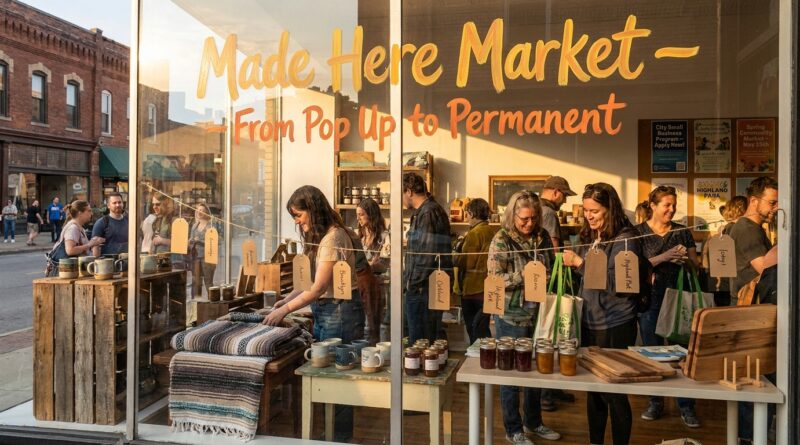
The Pop Up to Permanent Shift: How Local Maker Markets Are Quietly Becoming Year‑Round Neighborhood Stores
You know the feeling. Saturday is buzzing, the local maker market is packed, and for a few hours your neighborhood feels like it has its own little economy. Then Monday shows up. The tents are gone, the folding tables are back in storage, and the soap maker, print artist, candle seller, and baker are suddenly hard to find again. That is frustrating for shoppers who want to buy local during a normal week, and it is exhausting for makers who are doing retail the hard way over and over.
The good news is that this gap is fixable. If you are wondering how to turn local maker markets into permanent stores, the answer is usually not one giant leap. It is a series of smaller, practical moves. Shared rent. Rotating shelf space. City support that already exists. A landlord willing to test a short-term setup. And neighbors who ask the right questions at the right time. Many communities are closer than they think to turning pop-up momentum into a year-round neighborhood shop.
⚡ In a Hurry? Key Takeaways
- A permanent maker store usually starts as a shared retail model, not a single business taking on full rent alone.
- Ask organizers about sales data, vendor demand, storage, staffing, and whether a short-term storefront test is possible this season.
- The best setups protect makers from high overhead while giving shoppers reliable hours, clear pricing, and easy ways to buy local all week.
Why weekend markets stall out
Pop-up markets are great at creating excitement. They are not always great at creating stability.
Makers spend time loading cars, setting up displays, packing unsold inventory, and hoping weather cooperates. Organizers are stuck booking permits, promoting each event, and rebuilding foot traffic from scratch. Shoppers show up once, love it, then forget where to find those same products three days later.
That is why so many people are now asking how to turn local maker markets into permanent stores. It is really a question about reducing friction. Make it easier for shoppers to return. Make it easier for makers to sell. Make it easier for neighborhoods to keep money close to home.
What a permanent version actually looks like
Most successful transitions do not begin with a big, polished boutique and a long lease. They begin with a shared store.
Common models that work
Co-op retail shelf space. Several makers share one storefront, one checkout area, and one set of open hours. Each maker pays a monthly fee, a sales commission, or both.
Market-to-store pilot. A weekend market tests a temporary holiday shop, a three-month lease, or a vacant storefront activation before going year-round.
Storefront plus event mix. The market keeps its weekend events but adds a smaller permanent shop that carries bestsellers and introduces new vendors.
Residency model. One or two makers rotate through featured space each month while a core retail area stays open. If that idea interests you, The Hyper-Local Residency: How Neighborhood ‘Maker in Residence’ Programs Turn Empty Corners Into Mini Factories shows how neighborhoods can turn underused space into visible, productive local business.
The signs your local market is ready for a store
Not every market should rush into permanent retail. Some are seasonal by design. Others simply do not have the vendor base yet. But a few signals usually show up when a market is ready to grow.
1. Shoppers keep asking where to buy during the week
This is a simple one. If customers regularly say, “Do you have a store?” or “Where can I find this on Tuesday?” that is demand talking.
2. Vendors are repeating the same setup burden
If makers are doing six events a month just to stay visible, that is a lot of labor that could be replaced with stable shelf space.
3. Bestselling products are predictable
A permanent store needs some consistency. If a group of vendors already knows what sells well, that lowers the risk.
4. There is local support sitting on the table
Many cities, downtown groups, and chambers of commerce already offer small business grants, facade support, vacancy activation help, signage help, or low-cost technical support. These programs often go underused because residents and makers do not know to ask.
Questions shoppers should ask organizers this month
You do not need to be a developer or retail expert to help. Sometimes the right question from a regular customer is enough to move an idea from “maybe someday” to “let’s test it.”
Ask these directly
Do you track which vendors sell out most often?
If the answer is yes, that data can help choose the first mix of products for a permanent store.
Have you explored a shared storefront or short-term lease?
This tells you whether the idea has already been discussed or if it still needs a push.
Is there a landlord nearby with an empty space that could be tested for 60 to 90 days?
A short pilot is often much easier than a full-year commitment.
What city or chamber programs have you already checked?
If organizers have not looked yet, that is an opening for volunteers or local business supporters to help research.
Would shoppers support a membership, preorder day, or community shopping night?
That kind of early commitment can show a future landlord there is real demand.
How to rally landlord interest without sounding unrealistic
Landlords are not charities. But many do respond to a practical case.
The pitch is not, “Please take a chance on a cute idea.” The pitch is, “Here is a low-risk way to activate a vacant space, increase foot traffic, and test demand.”
What gets attention
Short trial periods. Ninety days is easier to swallow than three years.
Shared occupancy. Multiple makers mean the rent burden is spread out.
Simple buildout needs. Shelving, lighting, a checkout counter, and signs are less intimidating than a full renovation.
Existing audience. Email lists, Instagram followers, repeat market attendance, and event photos matter. They show traffic is not just theoretical.
Neighborhood benefit. An active storefront helps the block look alive, which can support nearby tenants too.
What to look for in city and chamber programs
This is where many good ideas get stuck. The support may already exist, but it is scattered across departments, websites, and grant pages written in plain old government language.
Look for these terms
Pop-up retail program
Often helps with short-term occupancy or permit support.
Vacancy activation
This usually means a program aimed at filling empty storefronts quickly.
Microbusiness grant
Small amounts of money can cover displays, signs, insurance, or point-of-sale tools.
Facade improvement
Helpful if a storefront needs basic curb appeal work.
Business technical assistance
This may include bookkeeping help, licensing guidance, lease review support, or retail planning.
Main Street or downtown partnership support
These groups often know which landlords are flexible and which spaces can be tested first.
What makers need before saying yes
A permanent shop only works if it is better than the market grind. It should not just be a prettier form of burnout.
Non-negotiables for makers
Clear fee structure. Flat rent, commission, or hybrid. It needs to be understandable.
Inventory system. If products go missing or reporting is sloppy, trust falls apart fast.
Reliable staffing. Makers cannot all be expected to run the register every day.
Fair product mix. Too many similar items can hurt everyone.
Consistent open hours. Shoppers need to know the place is really there.
Start smaller than your imagination wants to
This is the part people skip. They picture the dream version first. The smarter move is to test the boring parts.
Can ten makers keep shelves stocked for eight weeks? Can the shop stay open on a rainy Wednesday? Can the register system handle split payouts? Can signage bring in people who never visited the market?
Those are not glamorous questions. They are the ones that decide whether the idea lasts.
Three practical next steps for neighbors
1. Visit the next market with a purpose
Do not just shop. Ask one organizer whether a shared storefront has been discussed and what the biggest blocker is.
2. Find one empty space nearby
Take note of a storefront that has been sitting quiet. Share it with organizers, downtown groups, or the chamber. Sometimes no one has connected the dots yet.
3. Offer one concrete kind of help
Research city programs. Build a simple interest form. Gather shopper emails. Introduce a landlord contact. Specific help beats general enthusiasm every time.
At a Glance: Comparison
| Feature/Aspect | Details | Verdict |
|---|---|---|
| Weekend pop-up market | Low overhead and high energy, but limited hours, weather risk, and repeated setup work for makers. | Great launchpad, weak long-term access. |
| Shared neighborhood store | Steady hours, year-round visibility, and shared costs across multiple vendors, with stronger need for systems and staffing. | Best path for turning local demand into stable local retail. |
| Short-term storefront pilot | Tests rent, product mix, and foot traffic before a full commitment. Often supported by city, chamber, or landlord flexibility. | Smart middle step with lower risk. |
Conclusion
Right now, many neighborhoods are standing in the middle of a rare opening. Community markets are growing. City-backed small business programs are out there. Curated maker collectives are trying to create something that lasts. But these gains are not automatic. A market can easily stay a lovely weekend memory, or it can grow into a real neighborhood store that gives makers stable shelf space and gives residents a reliable place to buy local on an ordinary Tuesday.
If you have been wondering how to turn local maker markets into permanent stores, the answer starts with paying attention and asking better questions. Ask organizers what data they have. Ask which landlord might test a space. Ask what chamber or city help is going unused. Those small conversations can keep money circulating in the neighborhood instead of drifting back online. And they can help Made In Here play the useful role it should, connecting civic efforts, market organizers, makers, and everyday shoppers into one focused push.